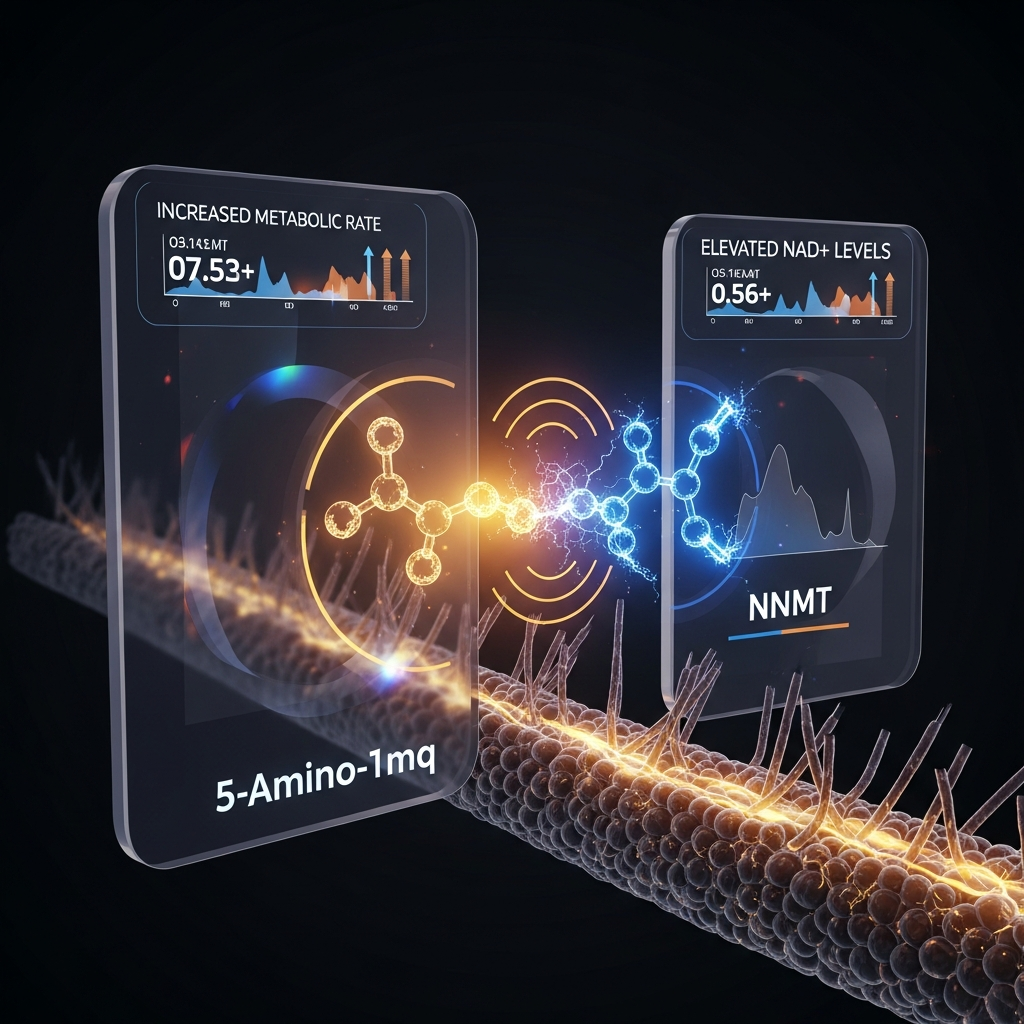
5-Amino-1MQ is geen stimulans. Het is een dedicated NNMT-inhibitor — een vlijmscherp methylquinolinium-analoog dat het enzym Nicotinamide N-Methyltransferase (NNMT) selectief remt, waardoor de cellulaire NAD+ en SAM methyl-donor pools chirurgisch worden gepreserveerd. Geen catecholamine-piek, geen receptor-binding, geen sympathische cascade — puur mitochondriale efficiëntie via enzymatische pathway-shift.
Het biochemische uitgangspunt — een small-molecule NNMT-inhibitor met cellulair energie-effect
In het peptide- en small-molecule research-veld worden energie-modulerende research-compounds historisch gedomineerd door catecholamine releasers (amfetamine-analogen, ephedrine-references) of uncoupling agents (DNP-references in research-modellen) — beide met een onvermijdelijke systeem-belasting: sympathicus-activatie, cardiovasculaire druk, oxidatieve stress.
5-Amino-1MQ breekt dat paradigma volledig. Het is geen stimulans en geen ontkoppelaar — het is een specifieke enzym-remmer die NNMT (Nicotinamide N-Methyltransferase) blokkeert. NNMT methyleert nicotinamide (NAM) tot 1-methylnicotinamide (MNA) met behulp van SAM als methyl-donor → het resultaat is dubbele depletie: NAM wordt onttrokken aan de NAD+-recycling pathway, én SAM wordt verbruikt aan een energie-inefficiënte zijreactie.
Wanneer NNMT geblokkeerd wordt door 5-Amino-1MQ, gebeuren er twee parallelle dingen: (1) de NAD+-pool blijft intact — meer substraat voor sirtuines, PARP en mitochondriale energie-productie, en (2) SAM blijft beschikbaar voor essentiële methylering-reacties (DNA, histon- modificaties, neurotransmitter-synthese). Geen overhaul van de fysiologie — alleen het opheffen van een metabool lek.
5-Amino-1MQ (5-Amino-1-methylquinolinium iodide, MW: ~286 g/mol) is een small-molecule research-compound geoptimaliseerd voor selectieve NNMT- inhibitie met een Ki in lage μM-range in enzymatische assays.
"Stimulants steal tomorrow's NAD+. 5-Amino-1MQ stops the methyl-leak that wasted it."
In dat opzicht is 5-Amino-1MQ fundamenteel anders dan klassieke "energie research-compounds" — het werkt niet via centrale signaling, niet via receptor-binding, en niet via uncoupling. Het opereert op enzym-niveau in vetweefsel, lever en andere NNMT-overexpresserende weefsels — een metabool-pure positie zonder sympathische of cardiovasculaire impact-markers.
Wat doet 5-Amino-1MQ vlijmscherp anders?
5-Amino-1MQ (5-amino-1-methylquinolinium, MW: ~286 g/mol) opereert op meerdere metabool-specifieke lagen tegelijk:
- NNMT enzymatische activiteit selectief geremd in vetweefsel en lever-cultures (Ki in lage μM-range)
- Cellulaire NAD+/NADH ratio verhoogd → meer substraat voor sirtuines (SIRT1/SIRT3) en PARP
- SAM/SAH ratio gepreserveerd → ondersteuning DNA-methylering, histon-modificaties en neurotransmitter-synthese
- Adipocyt-niveau fat-mass reductie in obese-research dier-modellen zonder eetlust-modulatie
- Mitochondriale biogenese ondersteund via SIRT1-PGC-1α pathway in chronische research
- Anti-aging research-signaal in seneschente cell-cultures (verlaagde p16, verhoogde Klotho expressie)
- Geen catecholamine release → geen cardiovasculaire druk, geen sympathische activatie markers
5-Amino-1MQ vs Traditionele Stimulantia — Side-by-Side
| Eigenschap | 5-Amino-1MQ (Enzymatic Modulator) | Traditionele Stimulantia (Catecholamine Releasers) |
|---|---|---|
| Type | Small-molecule NNMT-inhibitor | Sympathomimetische amines |
| Moleculaire massa | ~286 g/mol | 135-150 g/mol (amfetamine/ephedrine-range) |
| Werkingsmechanisme | Enzymatische pathway-modulatie (NNMT) | Norepinephrine/dopamine release |
| Primair onderzoeksdomein | Cellulaire energie-efficiëntie · NAD+-preservatie · vetweefsel-remodelling | Acute centrale activatie · sympathicus-respons |
| Catecholamine-piek | Afwezig | Sterk (signature effect) |
| Cardiovasculaire druk | Afwezig in research-modellen | Verhoogde bloeddruk + tachycardie |
| Centrale eetlust-modulatie | Afwezig | Sterk (anorexigeen effect) |
| NAD+/NADH ratio impact | Sterk verhoogd (signature effect) | Onveranderd of negatief in chronisch gebruik |
| SAM/SAH balans | Gepreserveerd | Niet primair beïnvloed |
| Mitochondriale biogenese (PGC-1α) | Geüpreguleerd via SIRT1 | Indirect of afwezig |
| Vet-mass reductie research-modellen | Aanwezig (obese-mouse data) | Aanwezig (anders mechanisme — eetlust) |
| Acute focus-respons | Afwezig | Sterk |
| Tachyfylaxie/receptor-downregulatie | Geen (enzym-doel) | Sterk in chronische blootstelling |
| Sympathische tone | Onveranderd | Verhoogd |
| HPLC-purity Primal lot | ≥99% | n/v (different supply chain) |
| Optimale onderzoeksrol | Mitochondriale efficiëntie research · langetermijn metabool | Acute focus/energie research (short-term) |
De biochemische conclusie: Traditionele stimulantia lenen neurotransmitters uit het zenuwstelsel voor acute prestaties — met als gevolg downregulatie, rebound en cardiovasculaire belasting. 5-Amino-1MQ stopt een metabool lek in de NAD+/SAM-cyclus zonder ergens iets te "lenen". Geen substituut voor stimulantia, maar een structureel ander research-instrument dat chronisch cellulaire energie-efficiëntie herstelt in plaats van acute pieken te genereren.
De Moleculaire Mechaniek
Op het niveau van enzymatische assays en cell-cultures zijn de volgende effecten van 5-Amino-1MQ gedocumenteerd:
- NNMT enzymatische activiteit selectief geremd in lever- en adipocyt-lysaten (Ki in lage μM-range, IC₅₀ goed gekarakteriseerd)
- MNA (1-methylnicotinamide) plasma-/cellulaire niveaus verlaagd → bevestiging downstream NNMT-blokkade
- NAM (nicotinamide) cellulaire concentratie verhoogd → meer substraat voor NAD+ salvage pathway
- NAD+/NADH ratio significant verhoogd in chronische research-modellen
- SAM/SAH ratio gepreserveerd → ondersteuning methylering-reacties (DNA, histonen, neurotransmitters)
- Selectiviteit voor NNMT versus andere methyltransferases (PNMT, COMT, INMT) bevestigd in selectiviteits-screens
Voor onderzoek naar vetweefsel-remodelling en mitochondriale efficiëntie levert 5-Amino-1MQ een uniek profiel — een onderzoeksdomein waar catecholamine-stimulantia niet binnen reiken:
- Adipocyt-mass reductie in diet-induced obese (DIO) muis-modellen zonder eetlust-modulatie
- Bruin vetweefsel thermogenesis-respons ondersteund via SIRT1-PGC-1α-UCP-1 cascade in BAT-cultures
- White adipose tissue (WAT) "browning"-markers verhoogd (CIDEA, UCP-1 expressie)
- Lever-vet (NAFLD-research) verlaagd in chronische dier-modellen
- Insuline-sensitiviteit ondersteund in obese-research modellen (verlaagde HOMA-IR)
- Mitochondriale densiteit verhoogd in skeletspier en adipocyt-cultures (mtDNA copy-number, TFAM expressie)
De meest unieke 5-Amino-1MQ eigenschap is de cross-over tussen metabool-efficiëntie en anti-aging research-mechanismen — via NAD+- gemedieerde sirtuine-activatie:
- SIRT1 activatie door verhoogd NAD+-substraat → downstream PGC-1α, FOXO3a, p53 modulatie
- SIRT3 activatie in mitochondria → versterkte oxidatieve fosforylering-efficiëntie
- PARP-activiteit ondersteund voor DNA-repair zonder NAD+-depletie
- Senescente-marker p16(INK4a) verlaagd in chronisch-stress cell-cultures
- Klotho expressie verhoogd in nier- en vet-cultures (anti-aging research-signaal)
- Geen tachyfylaxie in chronische in-vitro modellen chronische blootstelling — enzymatische doel-eigenschap garandeert sustained respons
Het Primal Peptides standaard
Elke batch wordt onafhankelijk gevalideerd. De Certificate of Analysis (COA) is de bindende bron van waarheid voor elk lot — publiek beschikbaar, batch-specifiek en gegenereerd door een onafhankelijk derde-partij laboratorium voorafgaand aan verzending. Wij publiceren geen claims die niet per lot door de COA worden gedragen.
- 01RP-HPLC met UV-detection → purity ≥ 98–99%
- 02Mass spectrometry → moleculaire-massa bevestiging
- 03Janoshik 3rd-party verificatie → publieke COA per lot
Onze validatie-architectuur is opzettelijk minimalistisch en strikt: drie reproduceerbare assays, één onafhankelijke verificatie, één publiek certificaat. Voor het volledige analytische dossier van uw specifieke batch raadpleegt u de COA bij uw verzending of via onze publieke verificatie-pagina.
5-Amino-1MQ moduleert centrale enzymatische pathways (NNMT) en beïnvloedt NAD+/SAM-pools systemisch. Onderzoeksprotocollen dienen NAD+/ NADH-baselines, SAM/SAH-ratios en eventuele co-administratie met andere methyl-donor research-compounds (NMN, NR, SAMe-references) strikt te controleren in dier-modellen. Hoewel cardiovasculaire impact in research- modellen minimaal is en geen catecholamine-cascade wordt geactiveerd, dient bij gebruik in genetisch gemodificeerde NNMT-knockout/overexpression modellen extra mechanistische monitoring te worden toegepast.
Wettelijke disclaimer: 5-Amino-1MQ is uitsluitend bestemd voor IN-VITRO RESEARCH. Niet voor humaan gebruik. Niet voor consumptie. Niet voor zelf-administratie als energie- of fat-loss aid.
Conclusie — De architect van cellulaire energie-efficiëntie
5-Amino-1MQ is niet de zoveelste stimulans. Het is een dedicated small- molecule NNMT-inhibitor die de cellulaire NAD+ en SAM-pools chirurgisch preserveert via selectieve enzym-blokkade — zonder receptor-binding, zonder catecholamine-piek, zonder sympathische cascade. Voor onderzoekers die metabool-remodelling, mitochondriale efficiëntie, adipocyt-browning en anti-aging research-mechanismen willen bestuderen op een moleculair gerichte manier — zonder de cardiovasculaire en neurologische belasting van klassieke stimulantia — is 5-Amino-1MQ het ontbrekende enzymatisch-pure research-instrument.
Efficiency over excitation. Preservation over piek. Architecture over arousal.