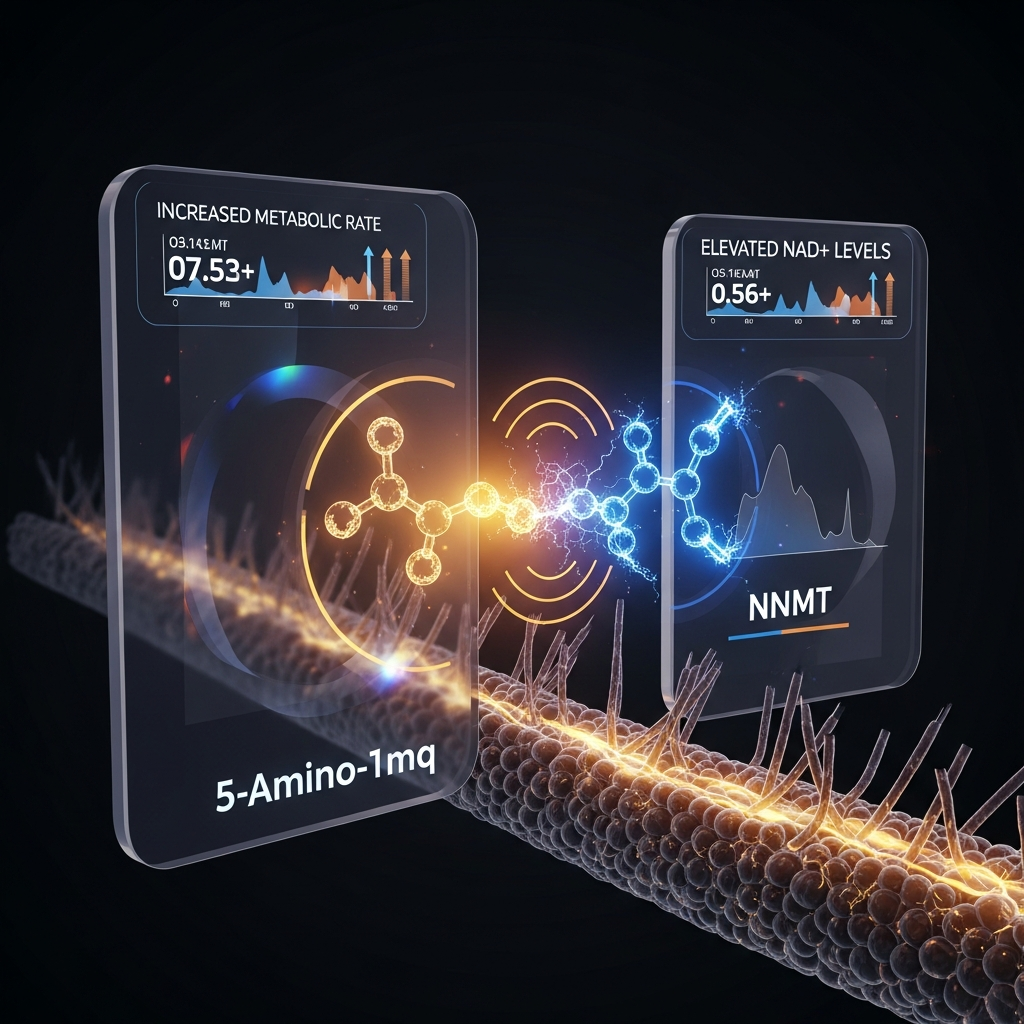
5-Amino-1MQ is not a stimulant. It is a dedicated NNMT inhibitor — a precision methylquinolinium analogue that selectively inhibits the enzyme Nicotinamide N-Methyltransferase (NNMT), thereby surgically preserving cellular NAD+ and SAM methyl-donor pools. No catecholamine spike, no receptor binding, no sympathetic cascade — purely mitochondrial efficiency via enzymatic pathway shift.
The biochemical premise — a small-molecule NNMT inhibitor with cellular energy impact
In the peptide and small-molecule research field, energy-modulating research compounds have historically been dominated by catecholamine releasers (amphetamine analogues, ephedrine references) or uncoupling agents (DNP references in research models) — both with unavoidable systemic burden: sympathetic activation, cardiovascular strain, oxidative stress.
5-Amino-1MQ breaks that paradigm entirely. It is neither a stimulant nor an uncoupler — it is a specific enzyme inhibitor that blocks NNMT (Nicotinamide N-Methyltransferase). NNMT methylates nicotinamide (NAM) to 1-methylnicotinamide (MNA) using SAM as methyl donor → the result is dual depletion: NAM is diverted from the NAD+ recycling pathway, and SAM is consumed in an energy-inefficient side reaction.
When NNMT is blocked by 5-Amino-1MQ, two parallel events occur: (1) the NAD+ pool remains intact — more substrate for sirtuins, PARP and mitochondrial energy production, and (2) SAM remains available for essential methylation reactions (DNA, histone modifications, neurotransmitter synthesis). No physiological overhaul — simply closure of a metabolic leak.
5-Amino-1MQ (5-Amino-1-methylquinolinium iodide, MW: ~286 g/mol) is a small-molecule research compound optimised for selective NNMT inhibition with Ki in the low μM range in enzymatic assays.
"Stimulants steal tomorrow's NAD+. 5-Amino-1MQ stops the methyl-leak that wasted it."
In that respect, 5-Amino-1MQ is fundamentally different from classical "energy research compounds" — it operates neither via central signalling, nor via receptor binding, nor via uncoupling. It operates at enzyme level in adipose tissue, liver and other NNMT-overexpressing tissues — a metabolically pure position without sympathetic or cardiovascular impact markers.
What does 5-Amino-1MQ do with surgical precision?
5-Amino-1MQ (5-amino-1-methylquinolinium, MW: ~286 g/mol) operates on multiple metabolically specific layers simultaneously:
- NNMT enzymatic activity selectively inhibited in adipose tissue and liver cultures (Ki in low μM range)
- Cellular NAD+/NADH ratio elevated → increased substrate for sirtuins (SIRT1/SIRT3) and PARP
- SAM/SAH ratio preserved → support for DNA methylation, histone modifications and neurotransmitter synthesis
- Adipocyte-level fat mass reduction in obese research animal models without appetite modulation
- Mitochondrial biogenesis supported via SIRT1-PGC-1α pathway in chronic research
- Anti-ageing research signal in senescent cell cultures (reduced p16, elevated Klotho expression)
- No catecholamine release → no cardiovascular strain, no sympathetic activation markers
5-Amino-1MQ vs Traditional Stimulants — Side-by-Side
| Property | 5-Amino-1MQ (Enzymatic Modulator) | Traditional Stimulants (Catecholamine Releasers) |
|---|---|---|
| Type | Small-molecule NNMT inhibitor | Sympathomimetic amines |
| Molecular weight | ~286 g/mol | 135–150 g/mol (amphetamine/ephedrine range) |
| Mechanism of action | Enzymatic pathway modulation (NNMT) | Norepinephrine/dopamine release |
| Primary research domain | Cellular energy efficiency · NAD+ preservation · adipose tissue remodelling | Acute central activation · sympathetic response |
| Catecholamine spike | Absent | Strong (signature effect) |
| Cardiovascular strain | Absent in research models | Elevated blood pressure + tachycardia |
| Central appetite modulation | Absent | Strong (anorexigenic effect) |
| NAD+/NADH ratio impact | Strongly elevated (signature effect) | Unchanged or negative in chronic use |
| SAM/SAH balance | Preserved | Not primarily affected |
| Mitochondrial biogenesis (PGC-1α) | Upregulated via SIRT1 | Indirect or absent |
| Fat mass reduction research models | Present (obese mouse data) | Present (different mechanism — appetite) |
| Acute focus response | Absent | Strong |
| Tachyphylaxis/receptor downregulation | None (enzyme target) | Strong in chronic exposure |
| Sympathetic tone | Unchanged | Elevated |
| HPLC purity Primal lot | ≥99% | n/a (different supply chain) |
| Optimal research role | Mitochondrial efficiency research · long-term metabolic | Acute focus/energy research (short-term) |
The biochemical conclusion: Traditional stimulants borrow neurotransmitters from the nervous system for acute performance — with downregulation, rebound and cardiovascular burden as consequence. 5-Amino-1MQ stops a metabolic leak in the NAD+/SAM cycle without "borrowing" anything. Not a substitute for stimulants, but a structurally different research instrument that chronically restores cellular energy efficiency rather than generating acute peaks.
The Molecular Mechanics
At the level of enzymatic assays and cell cultures, the following effects of 5-Amino-1MQ have been documented:
- NNMT enzymatic activity selectively inhibited in liver and adipocyte lysates (Ki in low μM range, IC₅₀ well characterised)
- MNA (1-methylnicotinamide) plasma/cellular levels reduced → confirmation of downstream NNMT blockade
- NAM (nicotinamide) cellular concentration elevated → more substrate for NAD+ salvage pathway
- NAD+/NADH ratio significantly elevated in chronic research models
- SAM/SAH ratio preserved → support for methylation reactions (DNA, histones, neurotransmitters)
- Selectivity for NNMT versus other methyltransferases (PNMT, COMT, INMT) confirmed in selectivity screens
For research into adipose tissue remodelling and mitochondrial efficiency, 5-Amino-1MQ delivers a unique profile — a research domain where catecholamine stimulants cannot reach:
- Adipocyte mass reduction in diet-induced obese (DIO) mouse models without appetite modulation
- Brown adipose tissue thermogenesis response supported via SIRT1-PGC-1α-UCP-1 cascade in BAT cultures
- White adipose tissue (WAT) "browning" markers elevated (CIDEA, UCP-1 expression)
- Hepatic fat (NAFLD research) reduced in chronic animal models
- Insulin sensitivity supported in obese research models (reduced HOMA-IR)
- Mitochondrial density elevated in skeletal muscle and adipocyte cultures (mtDNA copy number, TFAM expression)
The most unique 5-Amino-1MQ property is the cross-over between metabolic efficiency and anti-ageing research mechanisms — via NAD+-mediated sirtuin activation:
- SIRT1 activation through elevated NAD+ substrate → downstream PGC-1α, FOXO3a, p53 modulation
- SIRT3 activation in mitochondria → enhanced oxidative phosphorylation efficiency
- PARP activity supported for DNA repair without NAD+ depletion
- Senescence marker p16(INK4a) reduced in chronic stress cell cultures
- Klotho expression elevated in kidney and adipose cultures (anti-ageing research signal)
- No tachyphylaxis in chronic in-vitro models — enzymatic target property guarantees sustained response
The Primal Peptides standard
Every batch is independently validated. The Certificate of Analysis (COA) is the binding source of truth for each lot — publicly available, batch-specific and generated by an independent third-party laboratory prior to dispatch. We publish no claims that are not per-lot supported by the COA.
- 01RP-HPLC with UV detection → purity ≥ 98–99%
- 02Mass spectrometry → molecular mass confirmation
- 03Janoshik 3rd-party verification → public COA per lot
Our validation architecture is deliberately minimalist and rigorous: three reproducible assays, one independent verification, one public certificate. For the complete analytical dossier of your specific batch, consult the COA included with your shipment or via our public verification page.
5-Amino-1MQ modulates central enzymatic pathways (NNMT) and influences NAD+/SAM pools systemically. Research protocols should rigorously control NAD+/NADH baselines, SAM/SAH ratios and any co-administration with other methyl-donor research compounds (NMN, NR, SAMe references) in animal models. While cardiovascular impact in research models is minimal and no catecholamine cascade is activated, use in genetically modified NNMT knockout/overexpression models requires additional mechanistic monitoring.
Legal disclaimer: 5-Amino-1MQ is intended exclusively for IN-VITRO RESEARCH. Not for human use. Not for consumption. Not for self- administration as energy or fat-loss aid.
Conclusion — The architect of cellular energy efficiency
5-Amino-1MQ is not another stimulant. It is a dedicated small-molecule NNMT inhibitor that surgically preserves cellular NAD+ and SAM pools via selective enzyme blockade — without receptor binding, without catecholamine spike, without sympathetic cascade. For researchers seeking to study metabolic remodelling, mitochondrial efficiency, adipocyte browning and anti-ageing research mechanisms in a molecularly targeted manner — without the cardiovascular and neurological burden of classical stimulants — 5-Amino-1MQ is the missing enzymatically pure research instrument.
Efficiency over excitation. Preservation over peak. Architecture over arousal.