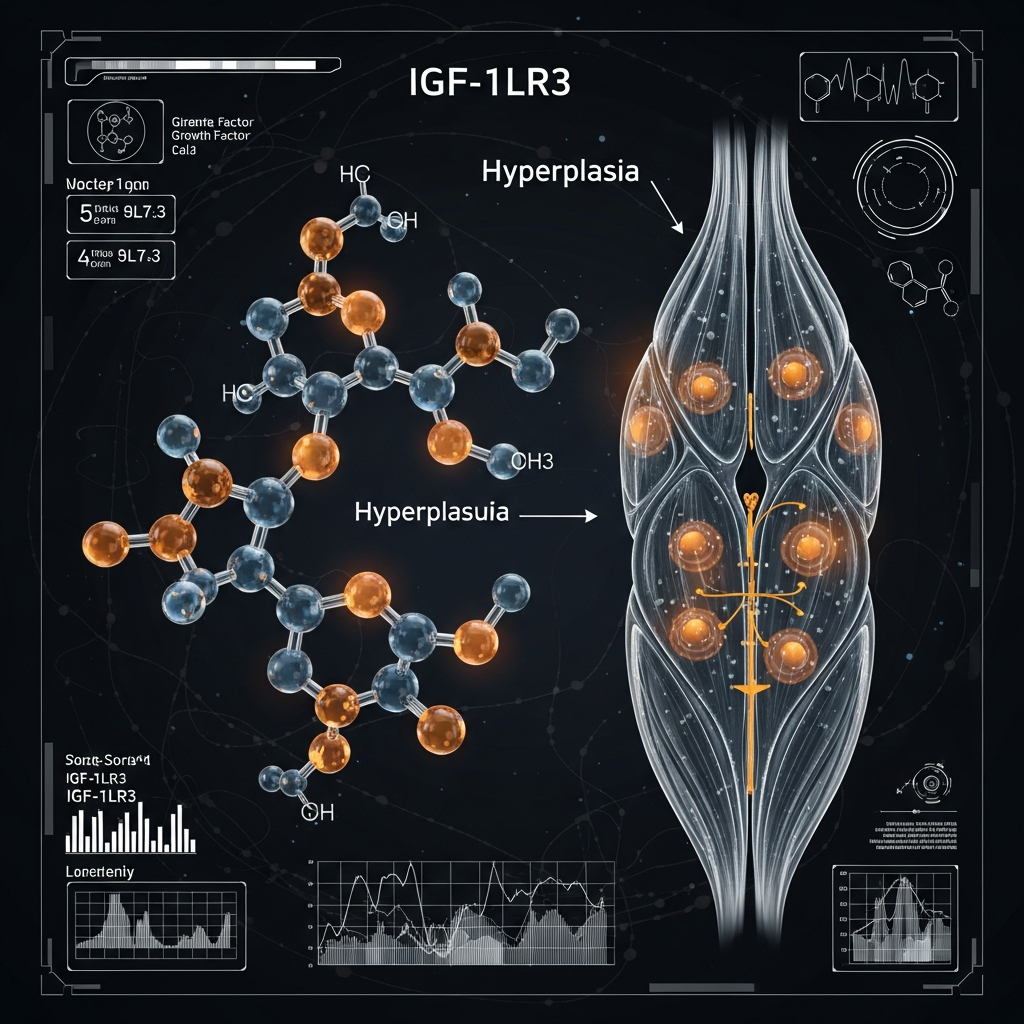
IGF-1LR3 is not a classical growth factor. It is a modified Long-R3 analog of endogenous IGF-1 with substantially extended half-life and IGFBP-binding bypass — a research tool for hyperplasia investigation where continuous receptor occupancy is the bottleneck.
The biochemical premise — an IGF-1 without brakes
Endogenous IGF-1 is biologically potent — but operationally intractable for research. >97% of circulating IGF-1 is bound to IGFBP-1 through IGFBP-6, the Insulin-like Growth Factor Binding Proteins. This binding drastically reduces bioavailable fraction and renders receptor-saturation studies virtually impossible without massive dosing.
IGF-1LR3 (Long-R3-IGF-1) fundamentally breaks with that structural brake. The analog carries two critical modifications:
- 01Arg³ substitution (Glu → Arg at position 3) — reduces IGFBP affinity by >3 orders of magnitude
- 02N-terminal 13-amino acid extension ("Long" peptide leader) — extends half-life from ~10 minutes (endogenous IGF-1) to 20-30 hours in research models
"Native IGF-1 is a signaling whisper drowned in IGFBP noise. IGF-1LR3 is the same signal — broadcast over an empty channel."
The result: a research vehicle that continuously and predictably occupies the IGF-1R receptor in cell cultures and animal models, with reproducible anabolic and hyperplastic output.
What does IGF-1LR3 do surgically different?
IGF-1LR3 (83-amino acid protein: 70-mer mature IGF-1 + 13-mer N-terminal leader) operates on multiple layers simultaneously:
- IGF-1R activation with ~3× longer receptor occupancy than native IGF-1
- PI3K/AKT/mTOR pathway sustained activation → protein synthesis amplification
- MAPK/ERK pathway parallel activation → proliferation signal
- Satellite cell activation in skeletal muscle models → hyperplasia instead of hypertrophy alone
- Anti-apoptotic cascade via BAD/BCL-2 modulation
- Glucose uptake stimulation with lower insulin-receptor cross-reactivity than native IGF-1
- Hepatic clearance bypass — reduced first-pass elimination vs endogenous IGF-1
IGF-1LR3 vs Standard IGF-1 — Side-by-Side
| Property | IGF-1LR3 (Long-R3 Analog) | Standard IGF-1 (Endogenous) |
|---|---|---|
| Amino acid count | 83-mer (70 + 13 leader) | 70-mer |
| Arg³ modification | Present (Glu → Arg) | Absent |
| IGFBP affinity | >1000× reduced | High (>97% bound in plasma) |
| Bioavailable fraction | >90% free in research buffer | <3% free in plasma |
| Half-life in vitro | 20-30 hours | ~10-15 minutes |
| Receptor occupancy in cultures | Continuous / predictable | Pulsed / fluctuating |
| Effective exposure (research) | 20-100× lower than native IGF-1 | High doses required |
| Hyperplasia response | Strong · satellite cell activation | Moderate (predominantly via hypertrophy) |
| Insulin-receptor cross-reactivity | Reduced vs native IGF-1 | Higher (relevant in glucose-uptake assays) |
| MAPK/ERK proliferation signal | Sustained | Transient (pulse) |
| HPLC purity Primal lot | ≥99% | n/a (endogenous, not as research product) |
| Reconstitution | Bacteriostatic water · −20 °C | n/a |
| Lyophilized stability | ≥36 months at −20 °C | Severely reduced |
| Research domains | Hyperplasia · satellite cell · sustained anabolic signaling | Receptor baseline studies |
The biochemical conclusion: Standard IGF-1 delivers pulses; IGF-1LR3 delivers continuous signaling with IGFBP-brake bypass. For research into hyperplasia, satellite cell recruitment, and sustained PI3K/AKT/mTOR activation, IGF-1LR3 is the reproducible research instrument where native IGF-1 hits its own biological dampeners.
The Molecular Mechanics
At the level of IGF-1R receptor occupancy and intracellular signaling cascades in cell cultures, the following effects are documented:
- Sustained IGF-1R phosphorylation for 18-24 hours post-administration — versus ~30-60 min for native IGF-1
- PI3K/AKT/mTOR sustained activation → protein synthesis pathway continuously open in 24h window
- MAPK/ERK proliferation cascade parallel active → satellite cell recruitment in muscle cultures
- Reduced IGFBP-1 through IGFBP-6 binding → >90% free fraction in research buffer
- Elevated receptor-recycling efficiency → IGF-1R remains available for repeated activation
- Anti-apoptotic response via BAD phosphorylation + BCL-2 stabilization
The most unique IGF-1LR3 property is shifting tissue response from pure hypertrophy (cell swelling) to actual hyperplasia (cell number increase):
- Satellite cell activation in skeletal muscle cultures within 12-24 hours → measurable myoblast recruitment
- Myogenesis marker upregulation (MyoD, Myf5, myogenin) in animal models
- Actual nuclear accretion in muscle fibers → hyperplasia instead of hypertrophy alone
- Cellular proliferation rate in fibroblast/myoblast co-cultures significantly elevated
- Enhanced stem cell niche maintenance → reproducible in long-duration cultures
- Sustained MAPK signal prevents cell cycle exit → extended proliferation window
For research into combined metabolic and anabolic response, IGF-1LR3 delivers unique advantages over solo growth-factor administration:
- Glucose uptake stimulation via IGF-1R activation without full insulin-receptor cross-reactivity
- Protein synthesis / protein breakdown ratio shift → net positive nitrogen balance in animal models
- Lipolysis modulation in adipocyte cultures → adipose tissue preservation during caloric restriction research
- Glycogen synthase activation parallel to protein synthesis → energy substrate coordination
- Synergy with GH/GHRH research (CJC-1295, Ipamorelin) → IGF-1LR3 functions as downstream amplifier
- Compatible with BPC-157 in regeneration models → local tissue repair + sustained anabolic drive
The Primal Peptides standard
Every batch is independently validated. The Certificate of Analysis (COA) is the binding source of truth for each lot — publicly available, batch-specific, and generated by an independent third-party laboratory prior to shipment. We publish no claims not substantiated per lot by the COA.
- 01RP-HPLC with UV detection → purity ≥ 98–99%
- 02Mass spectrometry → molecular mass confirmation
- 03Janoshik 3rd-party verification → public COA per lot
Our validation architecture is deliberately minimalist and rigorous: three reproducible assays, one independent verification, one public certificate. For the complete analytical dossier of your specific batch, consult the COA included with your shipment or via our public verification page.
IGF-1LR3 induces sustained IGF-1R signaling with reduced IGFBP brake. In research models, cell proliferation response must be strictly monitored — unregulated proliferation in long-term cultures or in models with elevated IGF-1R expression (certain cell lines) may occur. Glucose uptake and insulin-receptor cross-reactivity should be controlled alongside standard IGF-1R assays.
Legal disclaimer: IGF-1LR3 is exclusively intended for IN-VITRO RESEARCH. Not for human use. Not for consumption. Not for performance enhancement or clinical application.
Conclusion — The architect of muscle tissue expansion
IGF-1LR3 is not the peptide that transmits receptor pulses. It is the peptide that continuously occupies the IGF-1R receptor for 18-24 hours — a sustained-signaling research vehicle that enables hyperplastic response where native IGF-1 hits its own IGFBP dampeners. For researchers studying satellite cell dynamics, tissue hyperplasia, and sustained PI3K/AKT/mTOR activation in reproducible long-term models, IGF-1LR3 is the missing sustained-anabolic instrument.
Continuous over pulsed. Hyperplasia over hypertrophy alone.
IGF-1 LR3
Referenční standard přímo z Primal Peptides EU laboratoře — vakuově zabaleno, anonymizováno a diskrétně odesláno v rámci EU. Striktní −20 °C skladovací protokoly před odesláním garantují lot-integritu.
POUZE PRO IN-VITRO VÝZKUM · NE PRO POUŽITÍ U LIDÍ · GMP-COMPLIANT SYNTÉZA