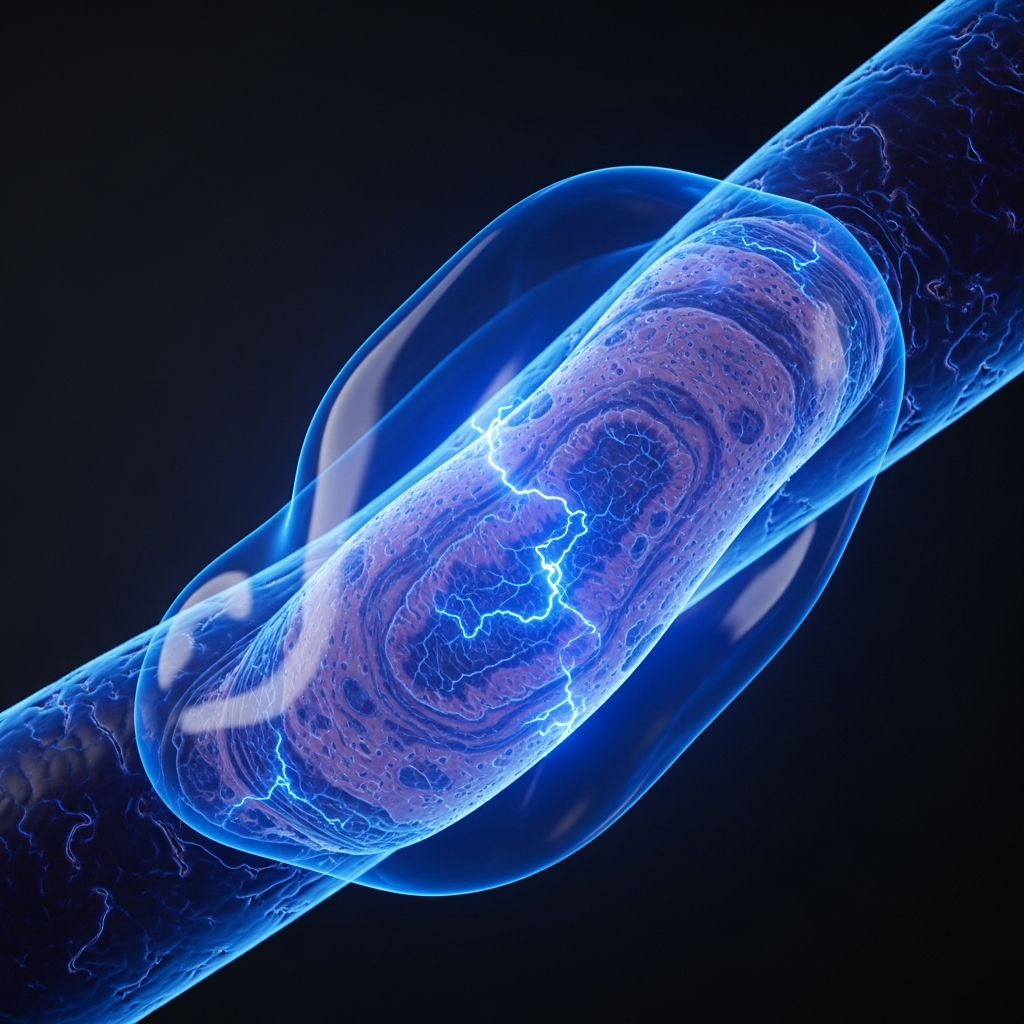
BPC-157 is not a growth factor. It is biological adhesive. As a synthetic derivative of a natural gastric protein, it enforces accelerated angiogenesis, tissue repair and cytoprotection — beyond what native biology can spontaneously deliver.
The peptide that protects the body from the source
BPC-157 — the abbreviation stands for Body Protection Compound, 15 amino acids — is a synthetic pentadecapeptide derived from a sequence in human gastric juice. Nature developed this fragment to protect the gastric wall against its own hostile environment. Researchers discovered that the isolated, stabilized sequence not only protects local gastric tissue — but operates systemically on virtually every tissue type where repair is required.
"BPC-157 doesn't replace a damaged signal. It rebuilds the signaling environment that makes repair possible at all."
In current in-vitro research, BPC-157 is the most reproducible peptide for investigating tissue integrity — a term encompassing musculoskeletal repair, GI-tract protection and neuroprotective mechanisms in one molecular pathway.
What does BPC-157 do razor-sharp differently?
BPC-157 (sequence: Gly-Glu-Pro-Pro-Pro-Gly-Lys-Pro-Ala-Asp-Asp-Ala-Gly-Leu-Val) operates on multiple layers simultaneously:
- VEGF modulation → direct angiogenesis induction in damaged tissues
- NO-pathway interaction → vascular homeostasis and perfusion response
- Growth factor cascade activation (FGF, EGF) → cellular proliferation signal
- Collagen synthesis acceleration → measurable type I/III ratio shift toward functional tissue
- Gastric mucosa protection in in-vitro models → epithelial barrier integrity
- BBB permeability modulation → neuroprotective response in CNS research models
- Stable via oral and parenteral routes in research models — unique for a 15-mer peptide
BPC-157 vs TB-500 — Side-by-Side
| Property | BPC-157 (Body Protection) | TB-500 (Thymosin β-4 fragment) |
|---|---|---|
| Peptide class | Pentadecapeptide · gastric juice derivative | Thymosin fragment · 17-mer |
| Mechanism of action | Local growth factor modulation · cytoprotection | Systemic actin sequestration · cell migration |
| Amino acid count | 15 | 17 (stabilized fragment) |
| Primary pathway | VEGF · NO · FGF/EGF cascade | G-actin pool · cytoskeletal mobilization |
| Local targeting | Very high | Moderate (systemically distributed) |
| Systemic distribution | Moderate (tissue-directed) | Strong · lymphatic |
| Angiogenesis induction | Strong (direct VEGF trigger) | Strong (via cell migration to vascular locus) |
| Gastric mucosa protection | Excellent — primary research domain | Not primary |
| Neuroprotection | Strong (BBB + neuronal response) | Moderate |
| Anti-fibrotic effect | Moderate | Strong |
| Action route in models | Subcutaneous · IM · orally stable | Subcutaneous · IM |
| Half-life in-vitro | ~4-6 hours | ~2-3 hours |
| HPLC purity Primal lot | ≥99% | ≥99% |
| Reconstitution | Bacteriostatic water · −20 °C | Bacteriostatic water · −20 °C |
The conclusion is razor-sharp: BPC-157 and TB-500 are complementary, not competitive. BPC-157 covers local tissue integrity + protection; TB-500 covers systemic mobilization + migration. Together they form the Wolverine Blend — separately they deliver data within their own research domain.
Benefits from preclinical research
Intestinal integrity research in in-vitro epithelial cell cultures and controlled animal models identifies the following effects of BPC-157 administration:
- Strengthening of tight junction proteins (occludin, claudin-1, ZO-1) in intestinal epithelial cultures
- Reduction of inflammation-induced permeability ("leaky gut" markers) in induced IBD models
- Faster mucosa regeneration after chemical or mechanical damage in gastric/duodenal models
- Modulation of gut microbiome response in indirectly measured animal studies — reduced dysbiosis post-stress
- Protection against NSAID-induced lesions in gastric models — most replicated BPC finding in literature
- Reduced inflammatory cytokine cascade in gut-associated lymphoid tissue (GALT) cultures
CNS research models identify reproducible neuroprotective mechanisms of BPC-157 — a research domain many peptides cannot access:
- Protection of dopaminergic neurons in 6-OHDA and MPTP induced Parkinson research models
- Modulation of serotonergic pathway — reproducible effect on anxiety/depression animal models
- BBB integrity maintenance in TBI (traumatic brain injury) research models
- Accelerated axonal regeneration in peripheral nerve crush models
- Reduction of neuroinflammation — decreased microglial activation in cell cultures
- Protection against excitotoxicity in glutamate-stressed neuronal cultures
- Synergy with dopaminergic and serotonergic research — BPC-157 enhances baseline response without receptor saturation
The Primal Peptides standard
Every batch is independently validated. The Certificate of Analysis (COA) is the binding source of truth for each lot — publicly available, batch-specific and generated by an independent third-party laboratory prior to shipment. We publish no claims not per-lot supported by the COA.
- 01RP-HPLC with UV detection → purity ≥ 98–99%
- 02Mass spectrometry → molecular mass confirmation
- 03Janoshik 3rd-party verification → public COA per lot
Our validation architecture is deliberately minimalist and strict: three reproducible assays, one independent verification, one public certificate. For the complete analytical dossier of your specific batch, consult the COA included with your shipment or via our public verification page.
BPC-157 induces enhanced angiogenesis in both damaged and healthy tissues — in research models, control cultures should run on non- damaged cells to monitor any off-target proliferative response. During prolonged exposure, VEGF marker levels should be continuously monitored.
Legal disclaimer: BPC-157 is intended solely for IN-VITRO RESEARCH. Not for human use. Not for consumption. Not for performance enhancement or clinical application.
Conclusion — The cytoprotection revolution
BPC-157 is not the peptide that opens new pathways. It is the peptide that gives existing repair pathways a biological deadline extension. For researchers seeking to study tissue integrity on multiple levels simultaneously — musculoskeletal, gastrointestinal and CNS — BPC-157 is the most foundational research instrument in the mainstream peptide pipeline.
Body Protection. Tissue Integrity. Research First.
BPC-157
Referencestandard direkte fra Primal Peptides EU-laboratoriet – vakuumforseglet, anonymiseret og diskret afsendt inden for EU. Strikte –20 °C lagringsprotokol før forsendelse garanterer lot-integritet.
KUN TIL IN-VITRO FORSKNING · IKKE TIL HUMAN BRUG · GMP-COMPLIANT SYNTESE