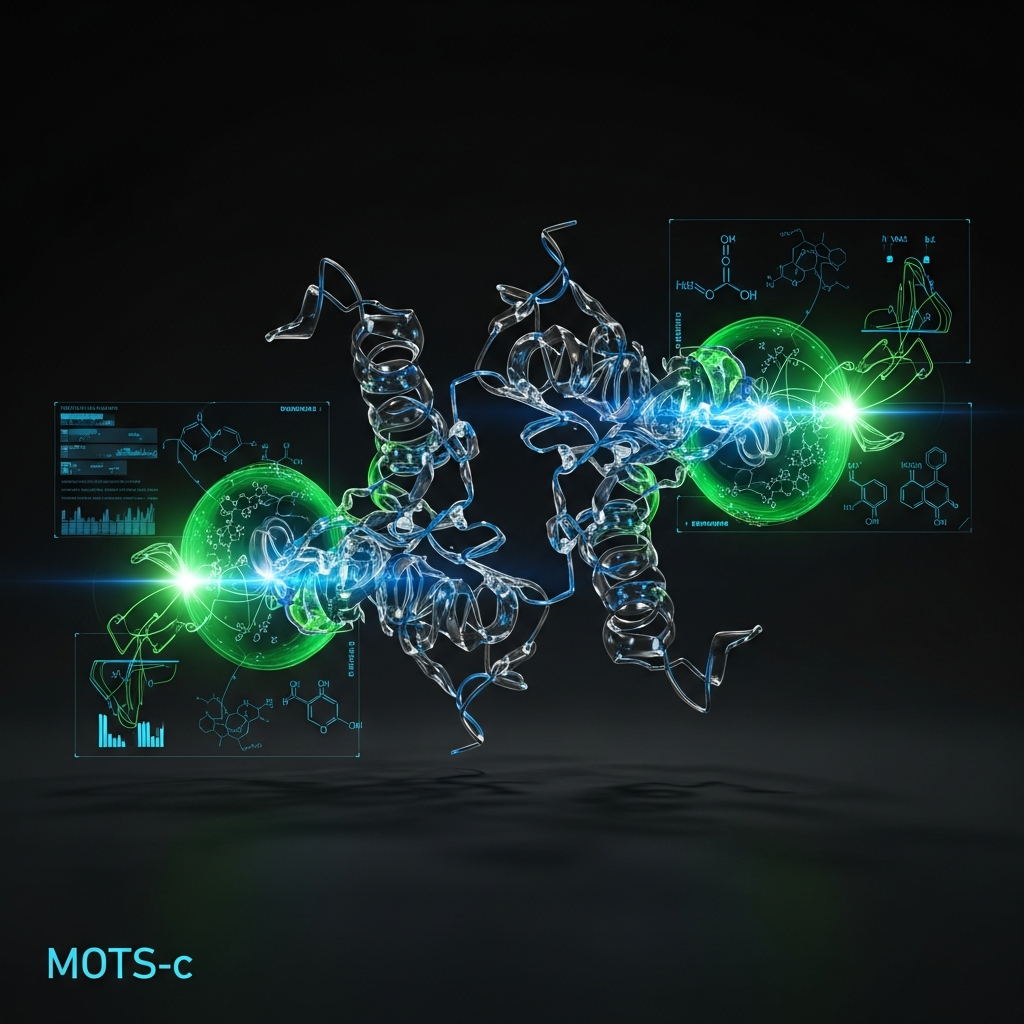
MOTS-c is not a classical peptide. It is a mitochondrial signal. A 16-amino-acid peptide encoded in the mitochondrial 12S rRNA gene that communicates nuclear gene expression with cellular energy status. The first metabolic regulator to cross the cell-organelle boundary at the molecular level.
The biochemical foundation — a peptide encoded in the mitochondrion
In most research models, mitochondrion-nucleus communication is approached via classical routes: ROS signalling, calcium flux, cytochrome c release. MOTS-c (Mitochondrial Open Reading frame of the Twelve S rRNA-c) breaks fundamentally with that paradigm. It is one of the first mitochondrial-derived peptides (MDPs) functioning as a direct peptide messenger between mitochondrion and nucleus — a biological pathway identified in 2015 that has since opened a new category of metabolic research.
"MOTS-c is the mitochondrion's own SMS to the nucleus. Direct peptide messaging — no second messengers, no relay-chain attenuation."
In this respect, MOTS-c is fundamentally different from classical metabolic modulators (metformin, AMPK activators, insulin sensitizers): it is not a receptor agonist or enzyme modulator, but an encoded peptide output of the mitochondrion itself — activated in response to metabolic stress and communicated to the nucleus to reprogram gene expression.
What does MOTS-c do razor-sharp differently?
MOTS-c (sequence: MRWQEMGYIFYPRKLR) operates on multiple layers simultaneously:
- Direct AMPK activation in skeletal muscle and liver cell cultures → metabolic signalling without ATP-depletion trigger
- GLUT4 translocation to the plasma membrane → insulin-independent glucose uptake in muscle cultures
- Folate cycle modulation → direct interaction with methionine-folate metabolism
- Nuclear translocation in metabolic-stress models → MOTS-c physically relocates from mitochondrion to nucleus
- Modulation of adaptive nuclear gene expression in response to physiological stress
- mTOR pathway interaction → balance between anabolism and autophagy without complete suppression
- Mitokine function → systemic signal from mitochondrion to peripheral tissues (the term "mitokine" was coined for MOTS-c)
MOTS-c vs Classical Metabolic Modulators — Side-by-Side
| Property | MOTS-c (Mitochondrial-Derived) | Classical Metabolic Modulators (Metformin / AMPK agonists) |
|---|---|---|
| Origin | Endogenous · encoded in 12S rRNA mtDNA | Synthetic / xenobiotic |
| Operating level | Mitochondrion ↔ nucleus messaging | Cytoplasmic enzyme modulation (ETC complex I / AMPK direct) |
| Target pathway | Direct AMPK activation + nuclear gene modulation | Indirect AMPK via ATP/AMP ratio-shift (metformin) |
| Amino acid count | 16 (short peptide) | n/a (small-molecule drugs) |
| Insulin-dependency | Independent (direct GLUT4 trigger) | Mostly insulin-sensitizing (indirect) |
| Mitokine function | Strong · systemic signalling | None — local enzyme effect |
| Folate cycle interaction | Directly modulated | No significant interaction |
| Lactate-acidosis risk in models | Not reported | Elevated with metformin (clinical context) |
| Cellular compartment-specificity | Mitochondrion → cytoplasm → nucleus | Cytoplasm / mitochondrion (no nuclear translocation) |
| Research position | Adaptive stress-response · longevity · metabolic flexibility | Glucose homeostasis · metabolic syndrome |
| HPLC-purity Primal lot | ≥99% | Variable (off-the-shelf pharmaceuticals) |
| Reconstitution | Bacteriostatic water · −20 °C | n/a (orally available) |
| Half-life in-vitro | ~30-60 minutes (rapid clearance) | Hours to days (varies per agent) |
The biochemical conclusion: Classical metabolic modulators intervene at downstream enzymes. MOTS-c is an upstream messenger from the mitochondrion itself — encoded in the organelle genome that evolved independently from the nuclear genome. A fundamentally different research instrument for fundamentally different metabolic research.
The Molecular Mechanics
At the level of metabolic pathway activation in skeletal muscle and liver cell cultures, the following molecular effects are documented:
- Direct AMPK phosphorylation at Thr172 → AMPK activation without ATP/AMP ratio-shift (unlike metformin)
- GLUT4 translocation from intracellular vesicles to plasma membrane within 30-60 min → insulin-independent glucose uptake
- Glycolysis flux increase in fasted-state muscle cultures → metabolic flexibility
- Folate cycle interaction → modulation of one-carbon metabolism (relevant for methylation research)
- Elevated mitochondrial biogenesis markers (PGC-1α expression) in animal models
- mTOR pathway balance → autophagy response without complete suppression of protein synthesis
The most unique MOTS-c property is physical translocation from mitochondrion to nucleus — a research domain that classical peptides do not make accessible:
- Nuclear translocation within 60-90 min after metabolic stress in cell cultures (glucose deprivation, oxidative stress)
- Direct transcription modulation → MOTS-c binds regulatory gene regions in the nucleus, not only surface receptors
- Adaptive gene expression program activation → cellular stress resistance, mitochondrial biogenesis, anti-oxidative response
- Heat-shock response synergy → amplifies HSP-mediated cytoprotection in stress models
- Mitokine systemic signal → MOTS-c detected in circulation, influences peripheral tissues at distance
- Age-related decline reversal in animal models → MOTS-c serum levels decline with age, supplementation restores baseline metabolic flexibility
For research into longevity pathways and metabolic flexibility, MOTS-c delivers reproducible research data that other peptides do not replicate:
- Increased metabolic flexibility in animal models → smoother switch between carbohydrate and lipid oxidation
- Reduced insulin-resistance markers in obese/aged mouse models (HOMA-IR equivalent)
- Mitochondrial capacity restoration in aging research → restoration of baseline ATP production capacity
- Senescence-marker reduction (p21, p16) in cell cultures with chronic metabolic stress
- Compatible with caloric-restriction research → MOTS-c pathway is one of the common endpoints of CR protocols in animal models
The Primal Peptides standard
Every batch is independently validated. The Certificate of Analysis (COA) is the binding source of truth for each lot — publicly available, batch-specific and generated by an independent third-party laboratory prior to shipment. We publish no claims that are not per-lot supported by the COA.
- 01RP-HPLC with UV-detection → purity ≥ 98–99%
- 02Mass spectrometry → molecular-mass confirmation
- 03Janoshik 3rd-party verification → public COA per lot
Our validation architecture is deliberately minimalist and strict: three reproducible assays, one independent verification, one public certificate. For the complete analytical dossier of your specific batch, consult the COA with your shipment or via our public verification page.
MOTS-c modulates mitochondrion-nucleus signalling at a pathway level not reached by classical modulators — in research models, nuclear-translocation kinetics and downstream transcription response must be strictly controlled via time-course baselines. Folate-cycle modulation may produce secondary effects on methylation-dependent processes.
Legal disclaimer: MOTS-c is intended exclusively for IN-VITRO RESEARCH. Not for human use. Not for consumption. Not for clinical or performance application.
Conclusion — The metabolic regulator encoded in the mitochondrion
MOTS-c is not the peptide that activates enzymes. It is the peptide that the mitochondrion itself uses to inform the nucleus of metabolic status — a 16-amino-acid biological SMS encoded in the mtDNA that evolved independently from the nuclear genome for billions of years. For researchers studying metabolic flexibility, longevity pathways and mitochondrion-nucleus communication at the most fundamental level, MOTS-c is the missing mitochondrial-tuned instrument.
From organelle to nucleus. Signal before substrate.
MOTS-c
Referencestandard direkte fra Primal Peptides EU-laboratoriet – vakuumforseglet, anonymiseret og diskret afsendt inden for EU. Strikte –20 °C lagringsprotokol før forsendelse garanterer lot-integritet.
KUN TIL IN-VITRO FORSKNING · IKKE TIL HUMAN BRUG · GMP-COMPLIANT SYNTESE