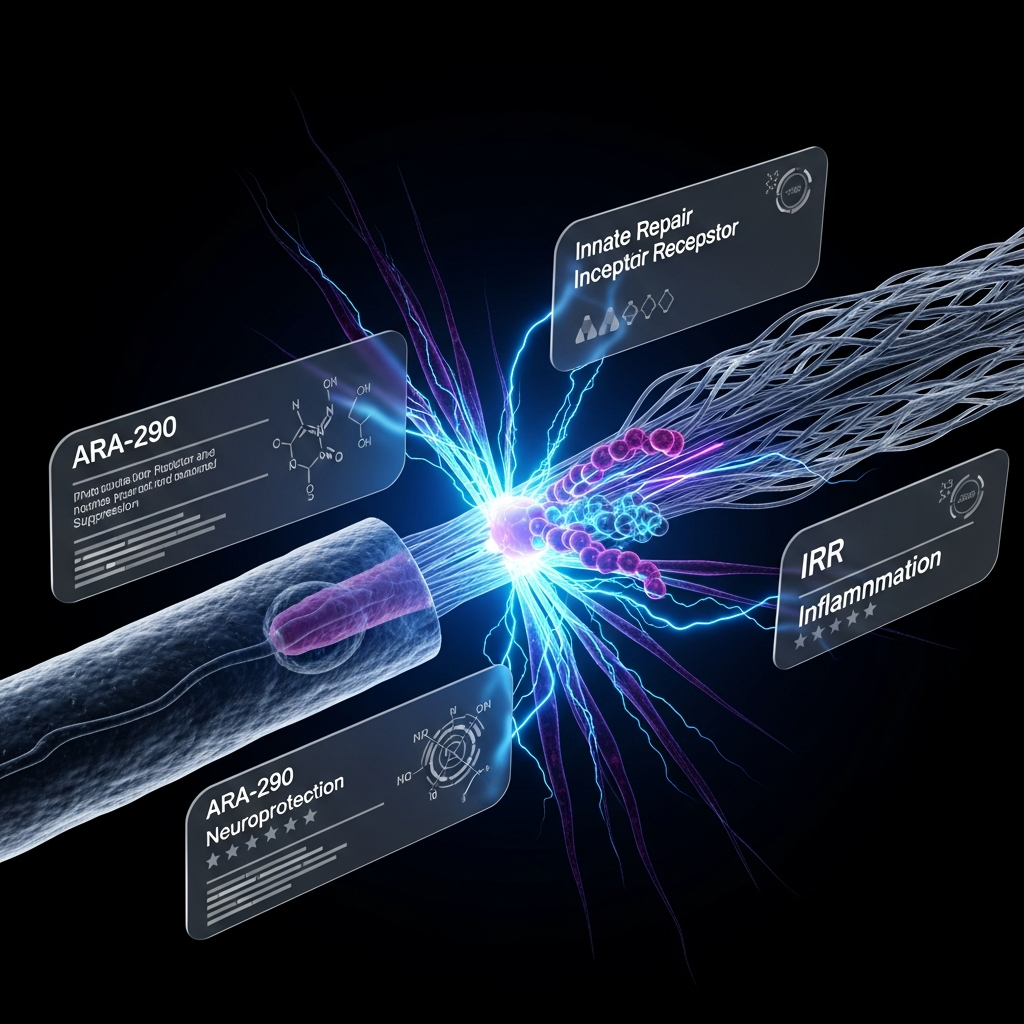
ARA-290 is not an EPO variant. It is a dedicated Innate Repair Receptor (IRR) agonist — an 11-amino acid synthetic peptide derived from helix B of erythropoietin that exclusively activates the tissue- protective heteromeric EPOR-βcR receptor. No erythropoiesis, no haematocrit rise, no thrombosis risk — only the anti-inflammatory and neuropathic-repair signal of EPO, surgically isolated.
The biochemical premise — an 11-mer helix-B peptide with dissociated EPO pharmacology
In the peptide research field, EPO (erythropoietin) was viewed for decades as one molecule with one function: erythropoiesis. Only in the 2000s did it become clear that EPO also carries a second, mechanistically distinct signal — a tissue-protective and anti-inflammatory effect that operates via a different receptor: the Innate Repair Receptor (IRR), a heteromer of EPOR + β-common receptor (βcR / CD131).
The problem in research models until then: as soon as you use EPO to study that tissue-repair signal, you unavoidably get the erythropoietic cascade as well — haematocrit rises, viscosity increases, thrombosis risk in chronic models becomes a confounder. For pure neuropathic repair or anti-inflammatory research, that is a surgical handicap.
ARA-290 breaks that paradigm. Through isolation of the helix B segment of EPO, an 11-mer peptide emerges (Cibinetide / Pyroglu-Glu-Gln- Leu-Glu-Arg-Ala-Leu-Asn-Ser-Ser, MW: ~1.257 kDa) that only activates the IRR heteromeric receptor. The EPOR homodimer binding sites responsible for erythropoiesis reside in a different segment of the full EPO molecule and are completely absent in ARA-290.
"EPO heals tissue and pumps red cells. ARA-290 heals tissue. Period."
In that respect, ARA-290 is fundamentally different from classical "tissue-repair research compounds" — it operates neither via vascular growth factors, nor via central signalling, nor via general tissue growth cascades. It operates via a dedicated innate repair receptor (IRR) in damaged or inflamed tissues — a surgically pure position without haematological or vascular confounders.
What does ARA-290 do with surgical precision?
ARA-290 (Cibinetide, 11-mer Helix-B-Surface peptide, MW: ~1.257 kDa) operates on multiple tissue-specific layers simultaneously:
- Selective IRR (EPOR-βcR heteromer) activation → only tissue-protective signal, no erythropoietic cascade
- No EPOR homodimer binding → no haematocrit rise, no reticulocyte response
- Anti-inflammatory response in chronic inflammation models → reduced TNF-α, IL-6, IL-1β
- Neurofunctional recovery in diabetic neuropathy models → measurable nerve conduction improvement
- Sarcoidosis-associated small-fibre neuropathy research response (clinical research data dossier)
- Anti-apoptotic response in stressed cells (elevated Bcl-xL, reduced caspase-3 activation)
- Tissue-specific action — IRR is upregulated on damaged/inflamed tissues, not on healthy cells
ARA-290 vs Standard EPO — Side-by-Side
| Property | ARA-290 (Tissue-Protective Selective) | Standard EPO (Pleiotropic) |
|---|---|---|
| Type | 11-mer synthetic peptide (Helix B fragment) | 165-mer glycoprotein |
| Sequence domain | Helix B Surface peptide (Pyroglu-EQLERALNSS) | Full EPO (1–165) |
| Molecular weight | ~1.257 kDa | ~30 kDa (heavily glycosylated) |
| Receptor selectivity | IRR (EPOR-βcR heteromer) ONLY | EPOR homodimer + IRR |
| Erythropoietic activity | Absent (signature selectivity) | Strong (signature effect) |
| Haematocrit rise | Absent | Strong in chronic exposure |
| Reticulocyte response | Absent | Elevated |
| Thrombosis risk research markers | Absent | Elevated in chronic models |
| Anti-inflammatory response | Strong (signature effect) | Present (one of many effects) |
| Neuropathic repair | Very strong in diabetic/sarcoidosis models | Present (mixed with erythropoiesis) |
| Anti-apoptotic response | Strong via IRR-JAK2-STAT5 | Strong via both pathways |
| Tissue selectivity (IRR upregulation) | High (damaged tissue only) | Not primary |
| Chronic exposure safety profile | Favourable in pre-clinical research models | Limited by erythropoietic cascade |
| HPLC purity Primal lot | ≥99% | n/a (different supply chain) |
| Optimal research role | Neuropathic repair · anti-inflammatory research | Erythropoiesis research · mixed endpoints |
The biochemical conclusion: Standard EPO is a pleiotropic glycoprotein — it simultaneously activates erythropoiesis (via EPOR homodimer) and tissue repair (via IRR). For mechanistic research into exclusively anti-inflammatory or neuropathic-repair pathways, that is a complication. ARA-290 is the surgically isolated tissue-repair pathway — the research peptide that enables study of innate repair mechanisms without the haematocrit rise and thrombosis markers inherent to full EPO. Not a substitute for EPO, but a mechanistically surgical instrument.
The Molecular Mechanics
At the level of receptor binding assays and cell cultures, the following effects of ARA-290 have been documented:
- Selective binding to EPOR-βcR heteromer (Innate Repair Receptor) in chemotaxis and binding assays
- No measurable binding to EPOR homodimer → absence of erythropoietic cascade
- JAK2-STAT5 signalling activated via IRR → tissue-protective transcription response
- PI3K-Akt pathway enhanced → anti-apoptotic cascade in stressed cells
- NF-κB pathway attenuated in chronic inflammation models
- HIF-1α modulation selective in damaged tissue where IRR is upregulated
For research into neuropathic repair — a research domain where full EPO is limited by erythropoietic side effects — ARA-290 delivers a unique profile:
- Diabetic neuropathy research models show improved nerve conduction (NCV) in chronic exposure
- Small-fibre neuropathy (sarcoidosis-associated) — clinical research dossier shows improvement in COMPASS-31 and SFN-SIQ scores
- Epidermal nerve fibre density (ENFD) elevated in skin biopsy models
- Neurotrophic response in DRG (dorsal root ganglion) cultures enhanced
- Anti-allodynia response in chronic pain models without central opioid modulation
- Wallerian degeneration attenuated in peripheral nerve injury models
The most unique ARA-290 property is surgically selective anti- inflammatory response — only on tissues that upregulate IRR under stress or damage:
- TNF-α, IL-6, IL-1β reduced in chronic inflammation cultures (macrophage cultures, microglia)
- Anti-apoptotic response in tubular epithelium (ischaemia/reperfusion kidney research)
- Cardiac ischaemia/reperfusion infarct zone reduced in MI research animal models
- Hepatic ischaemia protection in liver cultures
- Diabetes-associated endothelial dysfunction improved in chronic DM research models
- No broad immunosuppression — IRR selectivity ensures healthy immune functions remain unchanged
The Primal Peptides standard
Every batch is independently validated. The Certificate of Analysis (COA) is the binding source of truth for each lot — publicly available, batch-specific and generated by an independent third-party laboratory prior to dispatch. We publish no claims that are not per-lot supported by the COA.
- 01RP-HPLC with UV detection → purity ≥ 98–99%
- 02Mass spectrometry → molecular mass confirmation
- 03Janoshik 3rd-party verification → public COA per lot
Our validation architecture is deliberately minimalist and rigorous: three reproducible assays, one independent verification, one public certificate. For the complete analytical dossier of your specific batch, consult the COA included with your shipment or via our public verification page.
ARA-290 selectively activates the Innate Repair Receptor — no erythropoietic cascade. Research protocols should rigorously control IRR baselines, haematocrit/reticulocyte baselines (to verify absence of EPOR homodimer activation) and any co-administration with EPO references or ESAs (erythropoiesis-stimulating agents). No thrombosis risk has been documented in pre-clinical research models, but use in coagulopathy models requires parallel monitoring.
Legal disclaimer: ARA-290 is intended exclusively for IN-VITRO RESEARCH. Not for human use. Not for consumption. Not for self- administration as neuropathy therapy.
Conclusion — The architect of neuropathic repair
ARA-290 is not a weakened EPO. It is a surgically isolated helix-B- surface peptide that exclusively activates the Innate Repair Receptor (EPOR-βcR heteromer) — without erythropoiesis, without haematocrit rise, without thrombosis risk — and only on tissues that upregulate IRR under stress or damage. For researchers seeking to study neuropathic repair, anti-inflammatory signalling and tissue-protective mechanisms in a molecularly targeted manner — without the haematological and vascular burden of full EPO — ARA-290 is the missing selective tissue-repair instrument.
Repair over replication. Protection over proliferation. Selectivity over signal overflow.
ARA-290
Referenzstandard direkt aus dem Primal Peptides EU Labor – vakuumversiegelt, anonymisiert und diskret innerhalb der EU versandt. Strikte –20 °C Lagerungsprotokolle vor Versand garantieren Lot-Integrität.
NUR FÜR IN-VITRO-FORSCHUNG · NICHT FÜR DEN MENSCHLICHEN GEBRAUCH · GMP-KONFORME SYNTHESE