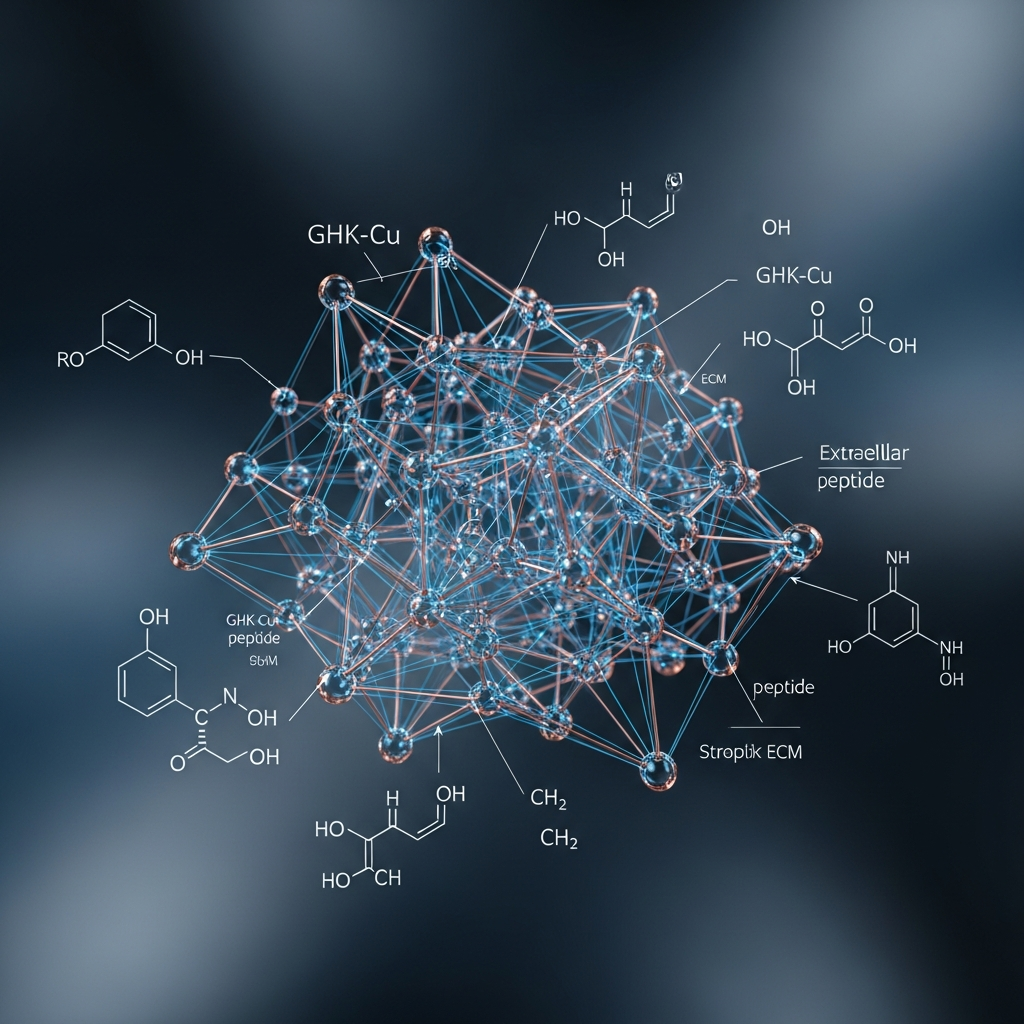
GHK-Cu is the architect of the Extracellular Matrix. A naturally occurring tripeptide (Glycyl-L-Histidyl-L-Lysine) with extraordinarily high copper affinity (Kd ≈ 10⁻¹⁶ M) that forces biology into razor-sharp equilibrium between tissue degradation and regeneration at the molecular level.
The biochemical foundation — a tripeptide with Cu²⁺ in lock-state
GHK-Cu is not a classical peptide. It is a metal-peptide complex: the tripeptide Gly-His-Lys chelates one Cu²⁺ ion with the highest affinity documented in the human serum protein spectrum. At normal physiological pH (7.4), >99.7% of the ion is bound to the tripeptide in in-vitro models.
"GHK-Cu is not a peptide that signals. It is a delivery vehicle for the most precisely-targeted Cu²⁺ ion in research-grade biochemistry."
In this respect, GHK-Cu is fundamentally different from classical growth-factor mimetics or receptor agonists. It operates via gene-expression modulation — in fibroblast cultures it shifts the expression of >4,000 genes with ≥50% modulation factor, the overwhelming majority clustering around ECM remodelling, DNA repair, anti-oxidative response and immunomodulation.
What does GHK-Cu do razor-sharp differently?
At the molecular level, verified mechanisms in in-vitro fibroblast/keratinocyte models include:
- TGF-β1 modulation → equilibrium between ECM synthesis and degradation, without fibrotic cascade
- Stimulation of decorin & versican expression → small leucine-rich proteoglycans (SLRPs) that regulate collagen fibril spacing
- Inhibition of MMP-2/MMP-9 at pathological concentrations, while baseline MMP-1/MMP-3 activity is preserved → targeted ECM remodelling
- Activation of p63 stem-cell marker in keratinocyte cultures → promotes basal-layer regeneration
- Cu²⁺-mediated activation of lysyl oxidase (LOX) → collagen/elastin cross-linking, structural tissue integrity
- Modulation of NF-κB pathway → targeted anti-inflammatory response without immunosuppression
- DNA-repair gene cluster upregulation → activation of BRCA1, MSH2, XRCC5 in microarray studies
GHK-Cu vs Conventional Modulators — Side-by-Side
| Property | GHK-Cu (Tripeptide-Cu²⁺) | Conventional ECM Modulators (Retinoids / Hydroxy Acids) |
|---|---|---|
| Operating level | Gene-expression modulation (>4000 genes) | Receptor-binding / pH-shift / enzymatic hydrolysis |
| Target pathway | TGF-β1 · LOX · MMP-balance · NF-κB · p63 | RAR/RXR (retinoid receptors) / surface-pH |
| ECM output | Selective: synthesis + targeted degradation | Non-selective: bulk degradation or bulk stimulation |
| Co-factor | Cu²⁺ (essential cofactor LOX, SOD, ceruloplasmin) | None (substrate-dependent) |
| DNA-repair gene cluster | Strongly upregulated (BRCA1, MSH2, XRCC5) | No significant effect |
| Anti-oxidative response | Multipath (Cu/Zn-SOD induction + glutathione) | Indirect / via user supplementation |
| Fibrosis risk | Very low (balanced TGF-β1 modulation) | Elevated with chronic use (retinoid fibrosis) |
| Immunomodulation | Targeted (NF-κB modulation without suppression) | Pro- or anti-inflammatory depending on class |
| Stability lyophilized | ≥36 months at −20 °C | Variable (photosensitive / pH-sensitive) |
| Research domains | ECM · DNA-repair · anti-inflammation · stem-cell niche | Hyperkeratosis · acne · surface correlation |
| HPLC-purity Primal lot | ≥99% | Variable per supplier |
| Reconstitution | Bacteriostatic water · −20 °C | n/a (ready-to-use) |
The biochemical conclusion: Conventional ECM modulators operate via brute substrate interaction. GHK-Cu programs cellular gene expression to redesign the ECM itself. A fundamentally different research question, a fundamentally different instrument.
The Molecular Mechanics
At the level of extracellular matrix remodelling in fibroblast cultures, the following molecular effects are documented:
- Increased collagen-type-I synthesis with simultaneous suppression of pathological type-III/I ratio-shift → functional tissue
- Decorin / versican / lumican upregulation → small leucine-rich proteoglycans regulate collagen fibril diameter and spacing at nanometer scale
- MMP-1/MMP-2 rebalancing → targeted degradation of denatured matrix components, no bulk degradation
- Hyaluronan synthesis stimulation via HAS2 upregulation → restoration of glycosaminoglycan water-binding matrix
- Elastin cross-linking via lysyl oxidase (LOX) activation — directly Cu²⁺-dependent enzyme
- Tenascin-C modulation → context-dependent ECM building-block for tissue transitions
Microarray studies on fibroblast cultures reveal a razor-sharp DNA repair profile — a research domain rarely made accessible by single peptides:
- Upregulation of BRCA1 / BRCA2 in fibroblast cultures (homologous recombination repair pathway)
- MSH2 / MSH6 activation (mismatch repair) → direct measurable reduction of replication-error frequency
- XRCC5 / XRCC6 induction (non-homologous end-joining) → repair of double-strand breaks
- p53-pathway modulation without pro-apoptotic cascade — cell-cycle control without cellular suicide
- Cu/Zn-SOD induction → reduces ROS-mediated DNA damage upstream
- Cellular senescence-marker reduction (p16, p21) in chronic stress models
For research into chronic inflammation models, GHK-Cu offers targeted intervention without immunosuppressive cascade:
- NF-κB pathway modulation — pathological signals are dampened, baseline immune response remains intact
- TNF-α / IL-1β / IL-6 reduction in macrophage cultures under induced inflammation
- TGF-β1 targeted modulation → inflammation resolution without fibrosis spiral
- Macrophage polarisation toward M2-phenotype in research models → pro-resolution rather than pro-inflammation
- Resolution-mediator (resolvin) pathway compatibility — synergistic with SPM-research (Specialized Pro-resolving Mediators)
The Primal Peptides standard
Every batch is independently validated. The Certificate of Analysis (COA) is the binding source of truth for each lot — publicly available, batch-specific and generated by an independent third-party laboratory prior to shipment. We publish no claims that are not per-lot supported by the COA.
- 01RP-HPLC with UV-detection → purity ≥ 98–99%
- 02Mass spectrometry → molecular-mass confirmation
- 03Janoshik 3rd-party verification → public COA per lot
Our validation architecture is deliberately minimalist and strict: three reproducible assays, one independent verification, one public certificate. For the complete analytical dossier of your specific batch, consult the COA with your shipment or via our public verification page.
GHK-Cu contains a biologically active Cu²⁺ ion in stoichiometric ratio. Research protocols must strictly control Cu-speciation and potential competition with other bivalent cations (Zn²⁺, Fe²⁺) in the buffer environment — free copper ions outside the chelation context are pro-oxidative rather than anti-oxidative.
Legal disclaimer: GHK-Cu is intended exclusively for IN-VITRO RESEARCH. Not for human use. Not for consumption. Not for topical or cosmetic application.
Conclusion — The architect of cellular integrity
GHK-Cu is not the peptide that activates receptors. It is the peptide that reshapes cellular gene expression itself — four process chains simultaneously (ECM, DNA repair, anti-oxidative response, immunomodulation) — via a single tripeptide-Cu²⁺ complex with the sharpest affinity in its class. For researchers building connective-tissue integrity, DNA-repair models and chronic inflammation resolution on a single molecular pillar, GHK-Cu is the missing biochemical instrument.
Architecture before regeneration. Sequence before structure.
GHK-Cu
Referenzstandard direkt aus dem Primal Peptides EU Labor – vakuumversiegelt, anonymisiert und diskret innerhalb der EU versandt. Strikte –20 °C Lagerungsprotokolle vor Versand garantieren Lot-Integrität.
NUR FÜR IN-VITRO-FORSCHUNG · NICHT FÜR DEN MENSCHLICHEN GEBRAUCH · GMP-KONFORME SYNTHESE