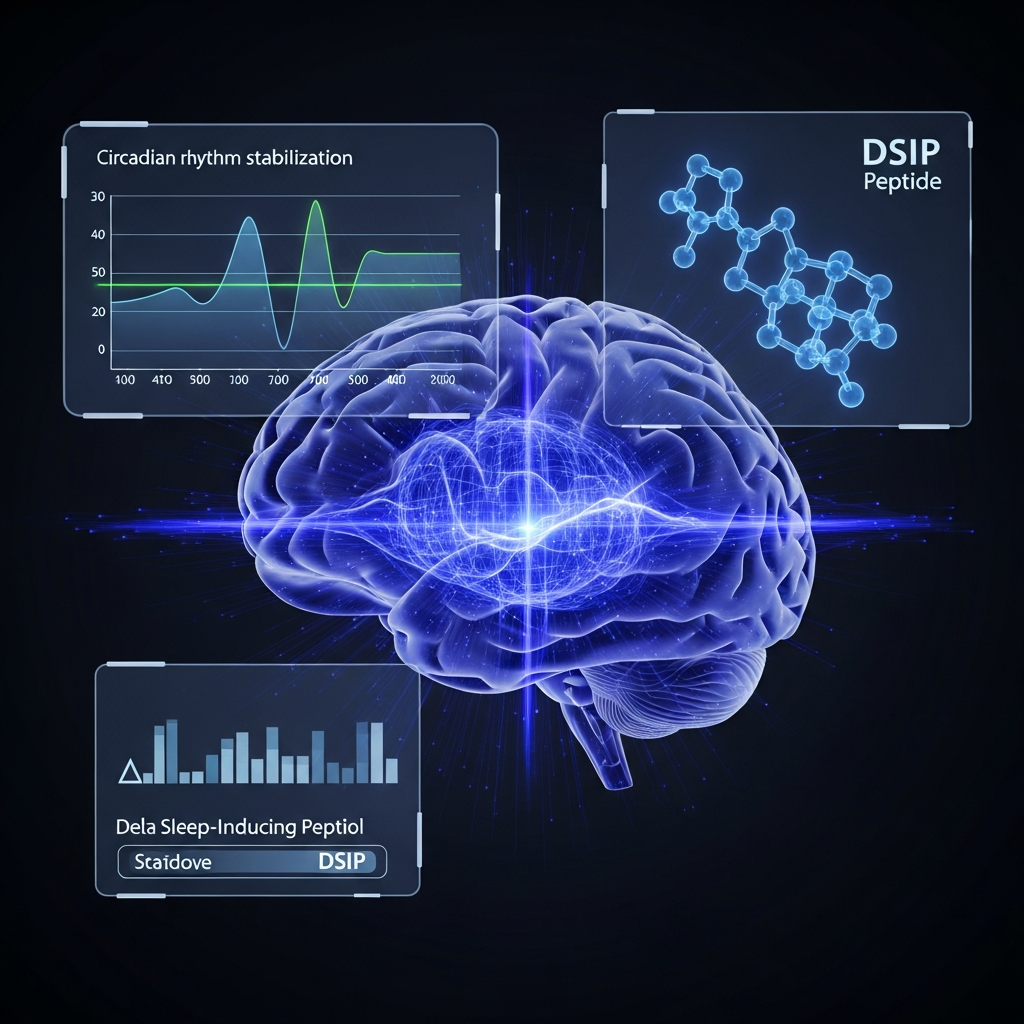
DSIP is not a classical sedative. It is a dedicated circadian stabiliser — a nonapeptide (Trp-Ala-Gly-Gly-Asp-Ala-Ser-Gly-Glu) that modulates delta-wave amplitude and slow-wave sleep architecture without GABA-A binding and without hangover. Discovered in 1977 in cerebral tissue of rabbits following electrical sleep induction.
The biochemical foundation — a nonapeptide endogenous to sleep architecture
In the peptide research field, sleep research is typically dominated by GABA-A agonists (benzodiazepine analogues, Z-drugs) or melatonin receptor agonists. Both have their limitations: GABA-A agonists suppress REM sleep and shorten slow-wave sleep (SWS); melatonin influences primarily phase position (when sleep begins), not architecture (how deep sleep goes).
DSIP breaks that paradigm. Instead of activating a receptor or shifting phase, it modulates central sleep regulation via hypothalamus-pituitary signaling and stabilises delta-wave amplitude in the slow-wave sleep phase. The result in preclinical models: measurable elevation of EEG delta-power, prolonged SWS duration and improved sleep continuity without REM suppression or next-day grogginess markers.
DSIP (Trp-Ala-Gly-Gly-Asp-Ala-Ser-Gly-Glu, MW: 848.81 g/mol) is a nonapeptide isolated by Schoenenberger and Monnier in 1977 from cerebral venous blood of rabbits during electrically induced slow-wave sleep — an endogenous factor that co-encodes homeostatic sleep pressure.
"Benzodiazepines flatten the brain. DSIP teaches it to dream deeper."
In that respect, DSIP is fundamentally different from classical "sleep research compounds" — it does not act as a sedative, not as a melatonin mimetic, and not as a GABA-A agonist. It operates upstream at the level of central sleep architecture and HPA-axis homeostasis — a more fundamental circadian position in the central nervous system.
What does DSIP do razor-sharp differently?
DSIP (WAGGDASGE, MW: 848.81 g/mol) operates on multiple layers simultaneously:
- EEG delta-power (1-4 Hz) amplitude elevated in slow-wave sleep phase → measurable in sleep-EEG animal models
- Slow-wave sleep duration prolonged without REM suppression → unique architecture response
- HPA-axis dampening → reduced nocturnal cortisol peak in chronic stress models
- Endogenous growth hormone (GH) pulse amplitude elevated during SWS → regeneration-phase support
- Beta-endorphin modulation → endogenous opioid tone stabilisation without receptor binding
- Anti-oxidative response in cerebral mitochondria → protection against oxidative stress during nocturnal metabolic shift
- Thermoregulation support → measurable reduction in core temperature during sleep phase
DSIP vs Melatonin — Side-by-Side
| Property | DSIP (Sleep Architecture) | Melatonin (Circadian Phase) |
|---|---|---|
| Type | Nonapeptide (9 AA) | Indole-amine (tryptophan derivative) |
| Sequence | Trp-Ala-Gly-Gly-Asp-Ala-Ser-Gly-Glu | N-acetyl-5-methoxytryptamine |
| Molecular weight | 848.81 g/mol | 232.28 g/mol |
| Endogenous origin | Cerebral venous blood (homeostatic sleep signal) | Pineal gland (circadian phase signal) |
| Primary research domain | Slow-wave sleep architecture · delta-power | Circadian phase · sleep-onset timing |
| Mechanism of action | HPA-axis · sleep-EEG architecture modulation | MT1/MT2 receptor agonism |
| EEG delta-power response | Strongly upregulated | Limited (indirect) |
| Slow-wave sleep prolongation | Yes (signature effect) | Not primary |
| REM sleep impact | No suppression | Minimal |
| Cortisol modulation | Nocturnal peak dampened | Limited |
| GH-pulse amplitude during SWS | Elevated | Unchanged |
| Receptor binding | No direct receptor agonism | MT1/MT2 high-affinity binding |
| Phase-shift potency | Minimal | Strong (dose & timing dependent) |
| HPLC-purity Primal lot | ≥99% | n/a (different supply chain) |
| Optimal research role | Sleep-depth research · regeneration | Sleep-onset timing research |
| Withdrawal/tachyphylaxis | None in chronic models | Possible MT desensitisation at high exposure |
The biochemical conclusion: Melatonin is a circadian phase signal — it tells the body when it is time for sleep (clock function). DSIP is a sleep-architecture stabiliser — it influences how deep slow-wave sleep goes (architecture function). Both are complementary, not substitutes. In comparative in-vitro models, DSIP+Melatonin is often positioned as a complete circadian research protocol — melatonin for timing, DSIP for depth.
The Molecular Mechanics
At the level of sleep-EEG and in-vivo polysomnography research models, the following effects of DSIP have been documented:
- EEG delta-power (1-4 Hz) significantly elevated in slow-wave sleep phase in rat and mouse models
- Prolonged SWS duration without REM sleep shortening — unique for sleep-modulating research compounds
- Reduced nocturnal arousal frequency in chronic stress models
- Improved sleep continuity (measured via sleep-fragmentation index)
- No next-day motor-impairment markers in rotarod and open-field test models
- Synergy with circadian light-cycle research — additive response at correct phase timing
For research into stress recovery and nocturnal metabolic homeostasis, DSIP delivers a unique profile:
- Nocturnal HPA-axis activity dampened → reduced corticosterone peak in chronic stress rat models
- Cortisol awakening response (CAR) stabilised in primate research models
- ACTH response to psychogenic stress reduced in preclinical models
- Reduced sympathetic tone during slow-wave sleep phase (lower nocturnal heart rate variability shift)
- Anti-stress response in chronic dysregulation models (chronic mild stress paradigm)
- HPA-rebound dampening following acute stress exposure
The most unique DSIP property is measurable support of the regeneration cascade during slow-wave sleep — a research domain where classical sleep research compounds do not reach:
- Endogenous GH-pulse amplitude during SWS elevated → anabolic regeneration-phase support
- Nocturnal IGF-1 baseline supported in chronic research models
- Anti-oxidative response in cerebral mitochondria (elevated GSH, reduced MDA markers)
- Reduced core temperature during sleep phase → measurable thermoregulation response
- Beta-endorphin modulation → endogenous opioid balance without receptor binding
- No tachyphylaxis in chronic in-vitro models chronic exposure — unique for sleep-modulating peptide research
The Primal Peptides Standard
Every batch is independently validated. The Certificate of Analysis (COA) is the binding source of truth for each lot — publicly available, batch-specific and generated by an independent third-party laboratory prior to dispatch. We publish no claims not per-lot substantiated by the COA.
- 01RP-HPLC with UV detection → purity ≥ 98–99%
- 02Mass spectrometry → molecular weight confirmation
- 03Janoshik 3rd-party verification → public COA per lot
Our validation architecture is deliberately minimalist and strict: three reproducible assays, one independent verification, one public certificate. For the complete analytical dossier of your specific batch, consult the COA with your shipment or via our public verification page.
DSIP modulates central sleep regulation and HPA-axis signaling simultaneously. Research protocols must strictly control circadian phase timing of exposure (typically pre-sleep window in research models), cortisol rhythms and any co-administration with other CNS-active research compounds (benzodiazepines, melatonin, GABAergic modulators) in animal models.
Legal disclaimer: DSIP is exclusively intended for IN-VITRO RESEARCH. Not for human use. Not for consumption. Not for self-administration as a sleep aid.
Conclusion — The architect of deep regeneration
DSIP is not just another sleep research compound. It is a dedicated circadian stabiliser that modulates delta-wave amplitude, slow-wave sleep architecture and HPA-axis homeostasis via central signaling — without receptor binding, without REM suppression, without hangover. For researchers who wish to study sleep architecture, nocturnal regeneration cascade and HPA-axis dampening in a molecularly targeted manner, DSIP is the missing nonapeptide instrument.
Depth over duration. Architecture over arrest. Homeostasis over hypnotic.
DSIP
Standard référence direct du laboratoire Primal Peptides EU – scellé sous-vide, anonymisé et expédié discrètement dans l'UE. Protocoles stricts de conservation −20 °C avant expédition garantissent l'intégrité du lot.
POUR RECHERCHE IN-VITRO UNIQUEMENT · NON DESTINÉ À L'USAGE HUMAIN · SYNTHÈSE CONFORME GMP