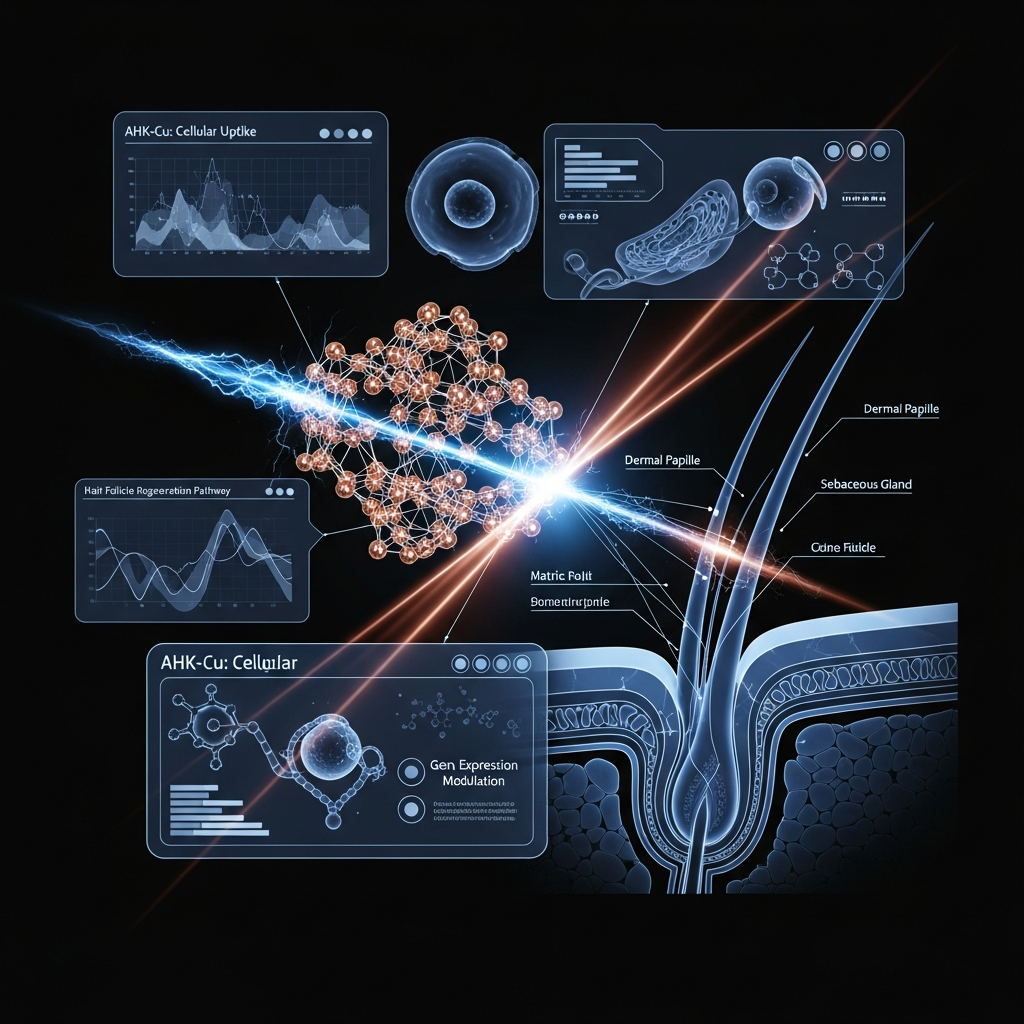
AHK-Cu is not GHK-Cu's little brother. It is a dedicated dermal papilla activator—a tripeptide-Cu²⁺ complex (Ala-His-Lys) with superior affinity for the hair follicle compared to its more famous predecessor. Specifically tuned to follicular signaling rather than general ECM remodeling.
The biochemical premise—a tripeptide-Cu²⁺ with dermal precision
In the peptide research field, every copper-peptide is quickly dismissed as a "variation on GHK-Cu." For AHK-Cu, that is a razor-sharp error. While both are tripeptide-Cu²⁺ complexes (3 amino acids + 1 copper ion), the selective tissue affinity and gene expression output are dramatically different.
AHK-Cu (Alanyl-L-Histidyl-L-Lysine·Cu²⁺) is a tripeptide with specific high affinity for dermal papilla cells—the mesenchymal signaling center at the base of the hair follicle that drives the growth cycle (anagen/catagen/telogen phasing).
"GHK-Cu modulates the ECM. AHK-Cu modulates the follicular signal that decides whether the ECM gets built at all."
In that respect, AHK-Cu is fundamentally different from classical "anti-hair-loss research peptides"—it does not function as a 5α-reductase inhibitor (like finasteride references in research models) or as a vasodilator (like minoxidil comparisons). It operates at the level of the dermal papilla itself—a more fundamental upstream position in the hair follicle signaling cascade.
What does AHK-Cu do razor-sharp differently?
AHK-Cu (Ala-His-Lys-Cu²⁺, MW: 340.85 g/mol) operates on multiple layers simultaneously:
- Dermal papilla cell proliferation → direct stimulation in in-vitro DPC cultures
- VEGF upregulation in dermal microvasculature → measurable angiogenesis around the follicle
- β-catenin / Wnt-pathway activation → driving force behind the anagen phase
- IGF-1 expression modulation in DPCs → autocrine growth factor signaling around the follicle
- Cu²⁺-mediated lysyl oxidase activation → reinforcement of peri-follicular connective tissue
- 5α-reductase inhibition in animal models—selective modulation without systemic androgen impact
- Pro-anagen phase conversion in telogen follicle models → measurable cycle shift
AHK-Cu vs GHK-Cu—Side-by-Side
| Property | AHK-Cu (Follicular Activator) | GHK-Cu (ECM Architect) |
|---|---|---|
| Sequence | Ala-His-Lys | Gly-His-Lys |
| Molecular mass | 340.85 g/mol (Cu²⁺-complex) | 403.93 g/mol (Cu²⁺-complex) |
| First residue | Alanine (CH₃ side chain, hydrophobic-light) | Glycine (no side chain, small/flexible) |
| Primary research domain | Dermal papilla · hair follicle signaling | General ECM remodeling · DNA repair |
| Target cell type | Dermal Papilla Cells (DPCs) | Fibroblasts · keratinocytes (general) |
| Wnt/β-catenin activation | Strong (anagen phase trigger) | Moderate (ECM context) |
| 5α-reductase inhibition in models | Present | Limited reporting |
| VEGF in dermal microvasculature | Strongly upregulated | Generally upregulated |
| Follicular cycle modulation | Pro-anagen · telogen-to-anagen shift | Not primary |
| General fibroblast response | Moderate | Strong · broad gene expression profile |
| DNA-repair gene cluster | Limited | Strong (BRCA1, MSH2, XRCC5) |
| Cu²⁺-stoichiometry | 1:1 (AAS-verified) | 1:1 (AAS-verified) |
| HPLC-purity Primal lot | ≥99% | ≥99% |
| Reconstitution | Bacteriostatic water · −20 °C | Bacteriostatic water · −20 °C |
| Optimal research role | Follicular signaling research | ECM/DNA-repair research |
The biochemical conclusion: GHK-Cu is the broadband ECM architect—it modulates thousands of genes around connective tissue, antioxidant response, and DNA repair. AHK-Cu is the narrowband follicular sharpshooter—it focuses the Cu²⁺ signal on the dermal papilla and the Wnt/β-catenin pathway that drives the hair follicle cycle. Both are complementary, not substitutes.
The Molecular Mechanics
At the level of dermal papilla cell (DPC) cultures and in-vitro follicular research models, the following effects of AHK-Cu are documented:
- DPC proliferation significantly elevated compared to untreated control cultures within 48-72 hours
- β-catenin nuclear translocation within DPCs—primary upstream signal for anagen phase entry
- Wnt-pathway downstream targets (AXIN2, LEF1, CCND1) upregulation in microarray studies
- IGF-1 autocrine expression in DPCs upregulated → local growth factor amplification without systemic impact
- Enhanced Cu²⁺-mediated lysyl oxidase activity → peri-follicular connective tissue reinforced
- Pro-anagen marker shift (Versican, Noggin upregulation)—measurable cycle phase transition in animal models
For research into peri-follicular microvasculature and the physiological growth environment around the hair follicle, AHK-Cu delivers reproducible advantages:
- VEGF-A expression in dermal endothelial cells upregulated → measurable capillary density around the follicle base
- PDGF-BB autocrine signaling activated → support of peri-follicular fibroblast response
- Elevated nutrient-delivery markers in in-vivo animal models—reinforcement of dermal microcirculation
- Anti-inflammatory response in scalp models (reduced IL-6, TNF-α in chronic inflammation cultures)
- Improved dermal collagen-IV profile in basement membrane around the hair root
- Synergy with topical co-research (PRP-mimic models, peptide formulation research)—additive response reported
The most unique AHK-Cu property is measurable modulation of the hair follicle cycle—a research domain where general copper peptides do not reach:
- Telogen-to-anagen conversion observed in animal models with induced telogen resting phase
- Shortening of catagen/telogen phase in cyclic research models
- Extended anagen phase duration—DPCs remain longer in pro-proliferative state
- 5α-reductase modulation in DPC cultures → reduced DHT impact without systemic androgen blockade
- Reduced follicle miniaturization markers in androgen-sensitive cell cultures
- Sustained signal in chronic exposure—no tachyphylaxis in animal models in extended in-vitro windows
The Primal Peptides standard
Every batch is independently validated. The Certificate of Analysis (COA) is the binding source of truth for each lot—publicly available, batch-specific, and generated by an independent third-party laboratory prior to shipment. We publish no claims not supported per lot by the COA.
- 01RP-HPLC with UV detection → purity ≥ 98–99%
- 02Mass spectrometry → molecular mass confirmation
- 03Janoshik 3rd-party verification → public COA per lot
Our validation architecture is deliberately minimalist and strict: three reproducible assays, one independent verification, one public certificate. For the complete analytical dossier of your specific batch, consult the COA with your shipment or via our public verification page.
AHK-Cu contains a biologically active Cu²⁺ ion in stoichiometric ratio. Research protocols must strictly control Cu speciation and potential competition with other bivalent cations (Zn²⁺, Fe²⁺) in the buffer environment. For follicular research models, DHT ratio in androgen-sensitive cultures should also be monitored parallel to DPC proliferation markers.
Legal disclaimer: AHK-Cu is intended exclusively for IN-VITRO RESEARCH. Not for human use. Not for consumption. Not for topical or cosmetic application.
Conclusion—The architect of hair regeneration
AHK-Cu is not a variation on GHK-Cu. It is a dedicated follicular signaling instrument that delivers the Cu²⁺ ion directly to the dermal papilla—the mesenchymal signaling center that drives the hair follicle cycle. For researchers who wish to study follicular activation, Wnt/β-catenin pathway in DPC cultures, and telogen-to-anagen cycle modulation in a molecularly targeted manner, AHK-Cu is the missing follicular copper-peptide instrument.
Same copper. Different precision. Follicle before fibroblast.
AHK-Cu
Standard referencyjny bezpośrednio z laboratorium Primal Peptides EU – próżniowo zamknięty, anonimizowany i dyskretnie wysłany w obrębie UE. Rygorystyczne protokoły przechowywania –20 °C przed wysyłką gwarantują integralność partii.
WYŁĄCZNIE DO BADAŃ IN-VITRO · NIE DO UŻYTKU LUDZKIEGO · SYNTEZA ZGODNA Z GMP