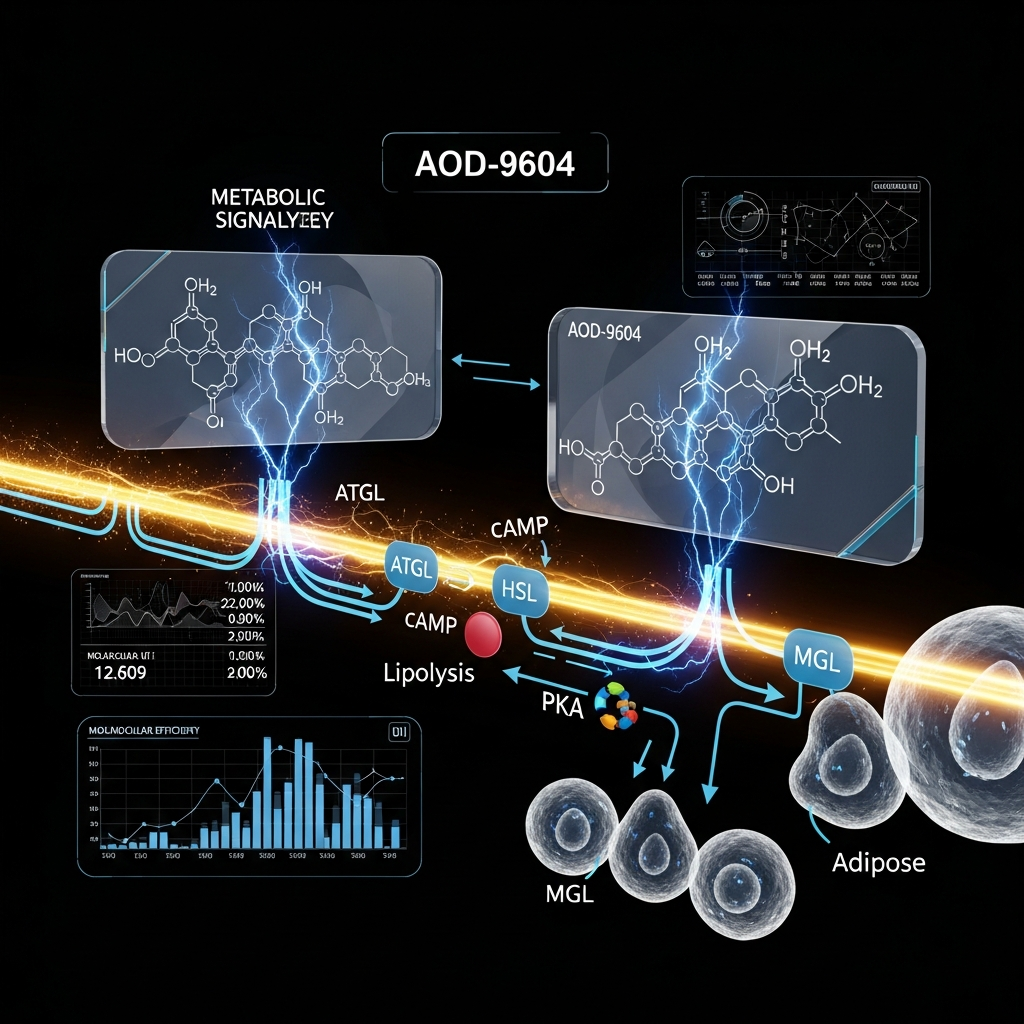
AOD-9604 is not an attenuated hGH fragment. It is a dedicated lipolytic research modulator — an optimized 16-mer C-terminal hGH fragment (Tyr-hGH 177-191) that selectively stimulates lipolysis and inhibits lipogenesis without IGF-1 elevation, without glucose dysregulation and without anabolic cascade. Monash University-developed for metabolic research without hGH burden.
The biochemical premise — an hGH fragment with separated pharmacology
In the peptide research field, lipolytic research mechanisms are usually dominated by full-length human growth hormone (hGH 191-mer) — and that brings an inevitable pleiotropic profile: lipolysis + IGF-1 elevation + glucose dysregulation + anabolic skeletal tissue response + cardiac muscle impact. For pure metabolic research, that is a razor-sharp handicap — impossible to mechanistically isolate lipolysis from confounding pleiotropy.
AOD-9604 breaks that paradigm. Through isolation of the C-terminal 177-191 fragment of hGH with an N-terminal tyrosine modification, a 16-amino acid peptide emerges that retains only the lipolytic pathway — the receptor binding sites responsible for IGF-1 upregulation, glucose impact and anabolic signaling reside elsewhere in the hGH molecule and are in AOD-9604 completely absent.
AOD-9604 (Tyr-hGH 177-191, MW: ~1.815 kDa) was isolated, optimized and characterized by Monash University and Metabolic Pharmaceuticals in a specific development line targeting lipolysis selectivity without hGH pleiotropy.
"hGH burns fat as a side-effect. AOD-9604 burns fat as its only effect."
In this respect, AOD-9604 is fundamentally different from classical "fat loss research peptides" — it does not work via hGH receptor binding, not via IGF-1 upregulation, and not via central appetite modulation. It operates directly at adipocyte level via beta-3 adrenergic receptor signaling and cAMP cascade — a metabolically pure position without anabolic or glycemic side-effect markers.
What does AOD-9604 do razor-sharp differently?
AOD-9604 (Tyr-hGH 177-191, MW: ~1.815 kDa) operates on multiple metabolic-specific layers simultaneously:
- Lipolysis selectively stimulated in white and brown adipocytes → measurable glycerol and free fatty acid release
- Lipogenesis inhibited → reduced de novo fatty acid synthesis in adipocyte cultures
- Beta-3 adrenergic receptor pathway activation → cAMP cascade upregulation in adipose tissue
- Hormone-sensitive lipase (HSL) phosphorylation elevated → enhanced triglyceride breakdown
- No IGF-1 elevation in serum baselines → absence of anabolic skeletal response
- No glucose dysregulation → insulin sensitivity baselines unchanged
- No central appetite modulation → operates outside the hypothalamus, unlike ghrelin/leptin mimics
AOD-9604 vs Full-Length hGH — Side-by-Side
| Property | AOD-9604 (Selective Lipolytic) | Full-Length hGH (Pleiotropic) |
|---|---|---|
| Type | 16-mer C-terminal fragment + Tyr | 191-mer full-length growth hormone |
| Sequence domain | hGH 177-191 + N-Tyr | hGH 1-191 (complete molecule) |
| Molecular mass | ~1.815 kDa | 22.1 kDa |
| Receptor binding | No hGH receptor binding | hGH receptor (GHR) high-affinity |
| IGF-1 upregulation | Absent | Strong (signature effect) |
| Lipolysis | Strong · selective signature effect | Present (one of many effects) |
| Lipogenesis inhibition | Strong | Limited |
| Glucose impact | Absent (no insulin resistance markers) | Elevated insulin resistance in chronic research models |
| Anabolic skeletal response | Absent | Strong (skeletal muscle hyperplasia/hypertrophy markers) |
| Cartilage/connective tissue | No impact | Strong growth in chronic exposure |
| Appetite modulation | Absent | Modal (via central signaling) |
| Carpal tunnel/edema markers | Absent | Present in chronic research |
| Beta-3 adrenergic pathway | Strong activator | Indirect |
| HSL phosphorylation | Strongly elevated | Moderate |
| HPLC purity Primal lot | ≥99% | n/a (different supply chain) |
| Optimal research role | Lipolysis-specific research · no IGF-1 burden | Pleiotropic hGH research (multiple endpoints) |
The biochemical conclusion: Full-length hGH is a pleiotropic endocrine signal — it simultaneously activates lipolysis, IGF-1 cascade, anabolism, glucose dysregulation and cartilage response. For mechanistic research into pure fat-metabolic routes, that is a complication. AOD-9604 is the separated lipolytic pathway — the research peptide that enables study of fat-metabolic mechanisms without the confounding IGF-1, glucose and anabolic cascades inherent to full-length hGH research. Not a substitute for hGH, but a surgically isolated research instrument.
The Molecular Mechanics
At the level of adipocyte cultures and in-vivo metabolic models, the following effects of AOD-9604 are documented:
- Glycerol release in 3T3-L1 adipocyte cultures significantly elevated within 30-60 min post-exposure
- Free fatty acid (NEFA) plasma levels elevated in obese-research animal models (Zucker rat, DIO mouse)
- Hormone-sensitive lipase (HSL) phosphorylation enhanced → triglyceride breakdown in lipid droplets
- Perilipin-A phosphorylation elevated → lipid droplet "unlocking" for lipase access
- Brown adipose tissue thermogenesis response enhanced (UCP-1 expression moderately elevated in BAT cultures)
- No tachyphylaxis in chronic in-vitro models with chronic exposure — adipocyte response remains stable
For research into metabolically pure research pathways, AOD-9604 delivers a uniquely selective profile — a research domain where full-length hGH does not reach:
- IGF-1 plasma baselines unchanged in chronic animal models (no anabolic cascade activation)
- Insulin sensitivity baselines stable → absence of glucose dysregulation markers
- No HbA1c shift in extended chronic research protocols
- Cortisol baselines unchanged → absence of stress-axis activation
- Skeletal muscle mass baselines stable → no anabolic confounding for pure fat research
- Cartilage/connective tissue markers unchanged → no growth response in chronic exposure
The most unique AOD-9604 property is selective beta-3 adrenergic receptor pathway activation — a mechanism that stimulates lipolysis without central or pleiotropic cascades:
- Beta-3 adrenergic receptor (ADRB3) downstream signaling enhanced in adipocyte cultures
- cAMP intracellular concentration elevated → PKA cascade activation
- Protein kinase A (PKA) phosphorylation of HSL and perilipin → lipase recruitment to lipid droplets
- CREB phosphorylation in BAT → mild thermogenic gene expression response (UCP-1, PGC-1α)
- Anti-lipogenic response via SREBP-1c and FAS downregulation in liver cultures (hepatic fat synthesis inhibited)
- No overlap with beta-1/beta-2 catecholamine pathways → no cardiovascular pressure markers in research models
The Primal Peptides standard
Every batch is independently validated. The Certificate of Analysis (COA) is the binding source of truth for each lot — publicly available, batch-specific and generated by an independent third-party laboratory prior to shipment. We publish no claims that are not per lot supported by the COA.
- 01RP-HPLC with UV detection → purity ≥ 98–99%
- 02Mass spectrometry → molecular mass confirmation
- 03Janoshik 3rd-party verification → public COA per lot
Our validation architecture is deliberately minimalist and strict: three reproducible assays, one independent verification, one public certificate. For the complete analytical dossier of your specific batch, consult the COA with your shipment or via our public verification page.
AOD-9604 activates beta-3 adrenergic pathway and lipolytic cascade selectively. Research protocols must strictly control NEFA baselines, glucose tolerance baselines (to verify absence of glycemic impact) and any co-administration with other catecholamine-modulating research compounds. While cardiovascular impact in research models is minimal, extra monitoring should be applied when used in obesity models with co-morbidity (cardiovascular research models).
Legal disclaimer: AOD-9604 is intended exclusively for IN-VITRO RESEARCH. Not for human use. Not for consumption. Not for self-administration as fat-loss aid.
Conclusion — The architect of metabolic selectivity
AOD-9604 is not another hGH fragment. It is a dedicated selective lipolytic research instrument that isolates the C-terminal 177-191 domain of hGH and retains only the lipolytic pathway — via beta-3 adrenergic receptor signaling and cAMP/PKA cascade — without IGF-1 elevation, without glucose dysregulation and without anabolic confounding. For researchers who wish to study fat-metabolic mechanisms, adipocyte-level lipolysis and lipogenesis inhibition in a molecularly targeted manner — without the pleiotropic cascade of full-length hGH — AOD-9604 is the missing metabolically pure instrument.
Selectivity over pleiotropy. Lipolysis over hypertrophy. Purity over potency.
AOD-9604
Standard referencyjny bezpośrednio z laboratorium Primal Peptides EU – próżniowo zamknięty, anonimizowany i dyskretnie wysłany w obrębie UE. Rygorystyczne protokoły przechowywania –20 °C przed wysyłką gwarantują integralność partii.
WYŁĄCZNIE DO BADAŃ IN-VITRO · NIE DO UŻYTKU LUDZKIEGO · SYNTEZA ZGODNA Z GMP