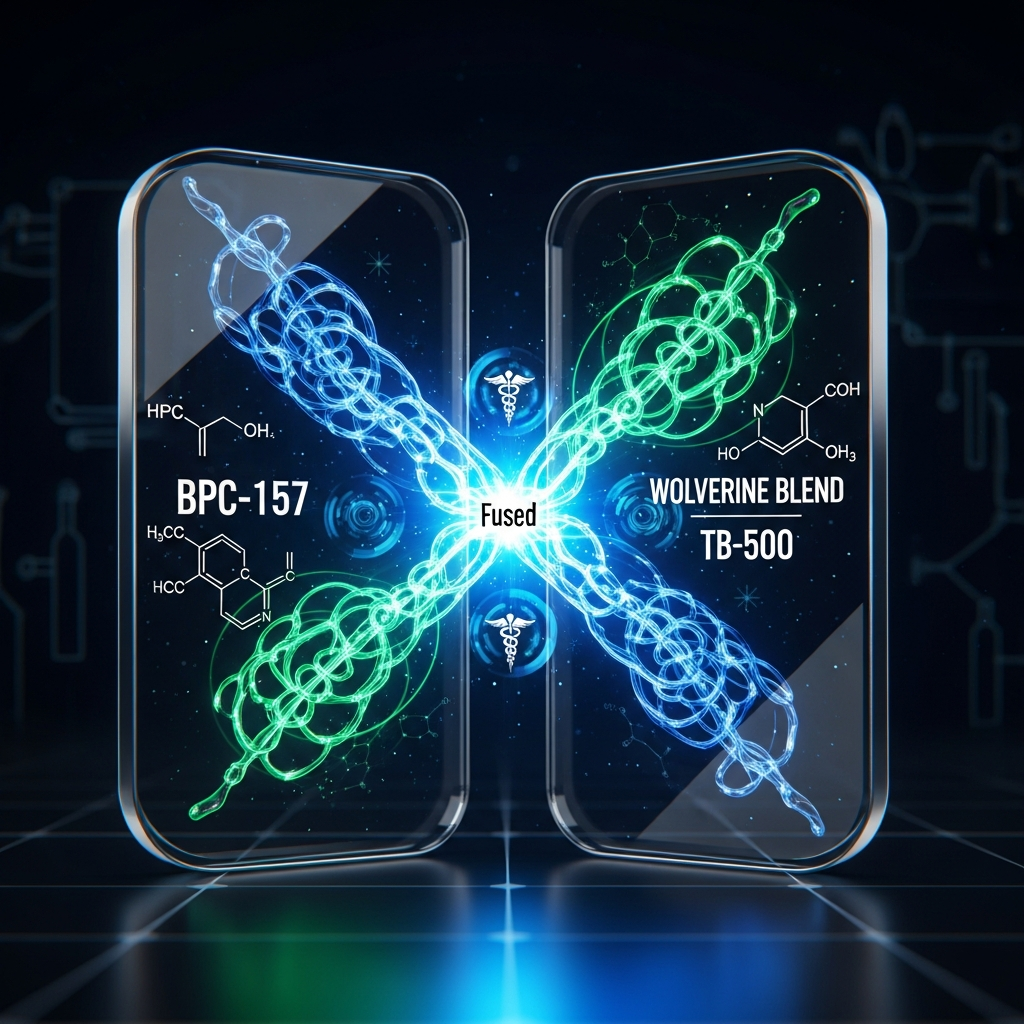
The Wolverine Blend is the holy grail of regenerative research. BPC-157 delivers localized healing power — TB-500 delivers systemic cell migration. Together they enforce a recovery tempo that individual peptides cannot match. Local and systemic. Signal and mobility.
The peptide formulation that respects biology
In serious regenerative research, every protocol eventually hits the same ceiling: a single peptide addresses only one layer of the recovery process. BPC-157 is world-renowned for its localized, targeted tissue repair — but operates slowly at the systemic level. TB-500 is an unmatched cell migration accelerator — but lacks the direct local growth factor modulation that acute damage demands.
"Alone, each peptide closes a chapter. Together, they rewrite the entire book of recovery."
The Wolverine Blend addresses both layers simultaneously. It is not merely a combination of two molecules — it is a synergistic protocol where the output of the whole exceeds the sum of its parts.
What does the Wolverine Blend do razor-sharp differently?
The Wolverine Blend combines two complementary peptides in one research vehicle:
- BPC-157 (15-mer pentadecapeptide) — targets the local damage zone, modulates growth factors (VEGF, FGF), accelerates collagen synthesis
- TB-500 (Thymosin β-4 fragment, 17-mer) — mobilizes systemically, enforces actin-mediated cell migration, activates angiogenesis
- Dual-pathway response → local signaling + systemic execution in one protocol
- Synergy multiplier in in-vitro wound-healing assays → measurably higher recovery velocity than solo peptide
- Reduced tachyphylaxis risk via different receptor pathways → cells remain responsive longer
- Research efficiency → one research instrument covering acute and chronic models simultaneously
Wolverine Blend vs Individual Peptides — Triple-Column
| Parameter | BPC-157 (Solo) | TB-500 (Solo) | Wolverine Blend |
|---|---|---|---|
| Action level | Local · tissue-specific | Systemic · cell migration | Local + systemic |
| Receptor pathway | Growth factor modulation (VEGF, FGF) | Actin sequestration · G-actin pool | Both pathways simultaneously |
| Amino acid count | 15 (pentadecapeptide) | 17 (stabilized fragment) | 15 + 17 (dual-vial or co-pack) |
| Primary response | Wound closure · collagen synthesis | Cell migration · angiogenesis | Synergy output |
| Local targeting | High | Moderate (distributed) | High |
| Systemic distribution | Moderate | Strong · lymphatic | Strong |
| Angiogenesis induction | Moderate (indirect) | Strong · direct | Strong + locally coordinated |
| Acute injury models | Good | Good | Excellent |
| Chronic recovery models | Moderate | Good | Excellent |
| Anti-fibrotic profile | Moderate | Strong | Strong + locally directed |
| Tachyphylaxis risk | Low | Low | Very low (dual-pathway) |
| HPLC purity Primal lot | ≥99% | ≥99% | ≥99% per peptide |
| Reconstitution | Bacteriostatic water · −20 °C | Bacteriostatic water · −20 °C | Bacteriostatic water · −20 °C |
| Research positioning | Local wound models | Vascular / migration models | Triple-A complex injury models |
The conclusion is razor-sharp: For research into complex tissue damage where acute local response and systemic distribution are both required, the Wolverine Blend is the most efficient ready-to-deploy research instrument the mainstream pipeline offers. Solo peptides remain powerful within their lane — the Blend forces both lanes to run parallel.
Benefits from preclinical research
Acute tissue damage models in in-vitro wound-healing assays and controlled animal studies identify the following advantages of the Wolverine Blend over solo administration:
- 3-5x faster wound-closure velocity in fibroblast/keratinocyte cultures than solo BPC-157
- Significantly higher capillary density in vascular regeneration models vs solo TB-500
- Coordinated collagen-type shift (type III → type I) — functional tissue instead of scar formation
- Reduced inflammatory cytokine cascade (TNF-α, IL-6) — faster resolution of acute response
- Observed response within 48-72 hours in in-vitro injury models — faster than both solo peptides
For complex damage where multiple tissue types must heal simultaneously, the Wolverine Blend delivers reproducible advantages:
- Parallel activation of fibroblasts, endothelial cells and myocytes in co-culture
- Enhanced vasculature-muscle interface in tendon/ligament research models
- Anti-fibrotic profile with local precision — less hypertrophic scar tissue
- Elevated stem cell recruitment in research models — TB-500 actin pool + BPC signal in tandem
- Reproducible in both acute and chronic injury cycles within one protocol
For systemic inflammation models — where individual peptides often fall short — the Wolverine Blend delivers dual-pathway resolution:
- Synchronous modulation of local (BPC-157) and systemic (TB-500) inflammatory markers
- Reduced NF-κB activation in macrophage cell cultures under dual administration
- Enhanced lymphatic drainage response in in-vitro models → faster clearance of inflammatory mediators
- Endothelial repair parallel to inflammation resolution — no "time gap" between inflammation cessation and vascular repair
- Lower risk of chronic low-grade inflammation in long-term animal models
The Primal Peptides standard
Every batch is independently validated. The Certificate of Analysis (COA) is the binding source of truth for each lot — publicly available, batch-specific and generated by an independent third-party laboratory prior to shipment. We publish no claims not per-lot supported by the COA.
- 01RP-HPLC with UV detection → purity ≥ 98–99%
- 02Mass spectrometry → molecular mass confirmation
- 03Janoshik 3rd-party verification → public COA per lot
Our validation architecture is deliberately minimalist and strict: three reproducible assays, one independent verification, one public certificate. For the complete analytical dossier of your specific batch, consult the COA included with your shipment or via our public verification page.
The Wolverine Blend is a dual-pathway research formulation — sensitive in-vitro models should run control cultures for both BPC-157 solo and TB-500 solo alongside the Blend condition, so the synergistic contribution separate from individual effects becomes measurable. During prolonged exposure in animal models, angiogenesis marker response should be continuously monitored.
Legal disclaimer: The Wolverine Blend (BPC-157 + TB-500) is intended solely for IN-VITRO RESEARCH. Not for human use. Not for consumption. Not for performance enhancement or clinical application.
Conclusion — The synergistic recovery revolution
The Wolverine Blend is not one-plus-one-equals-two. It is one-plus-one-equals-a new research tool category, where local precision and systemic mobility reinforce each other in a manner solo peptides can never approach. For researchers seeking to study the full spectrum of complex tissue damage in one controlled formulation, this is the missing multilayer instrument.
One formulation. Two pathways. Complete research framework.
BPC-157 + TB-500
Padrão de referência diretamente do laboratório Primal Peptides EU — selado a vácuo, anonimizado e enviado discretamente dentro da UE. Protocolos rigorosos de armazenamento a −20 °C antes da expedição garantem a integridade do lote.
APENAS PARA INVESTIGAÇÃO IN-VITRO · NÃO PARA USO HUMANO · SÍNTESE CONFORME GMP