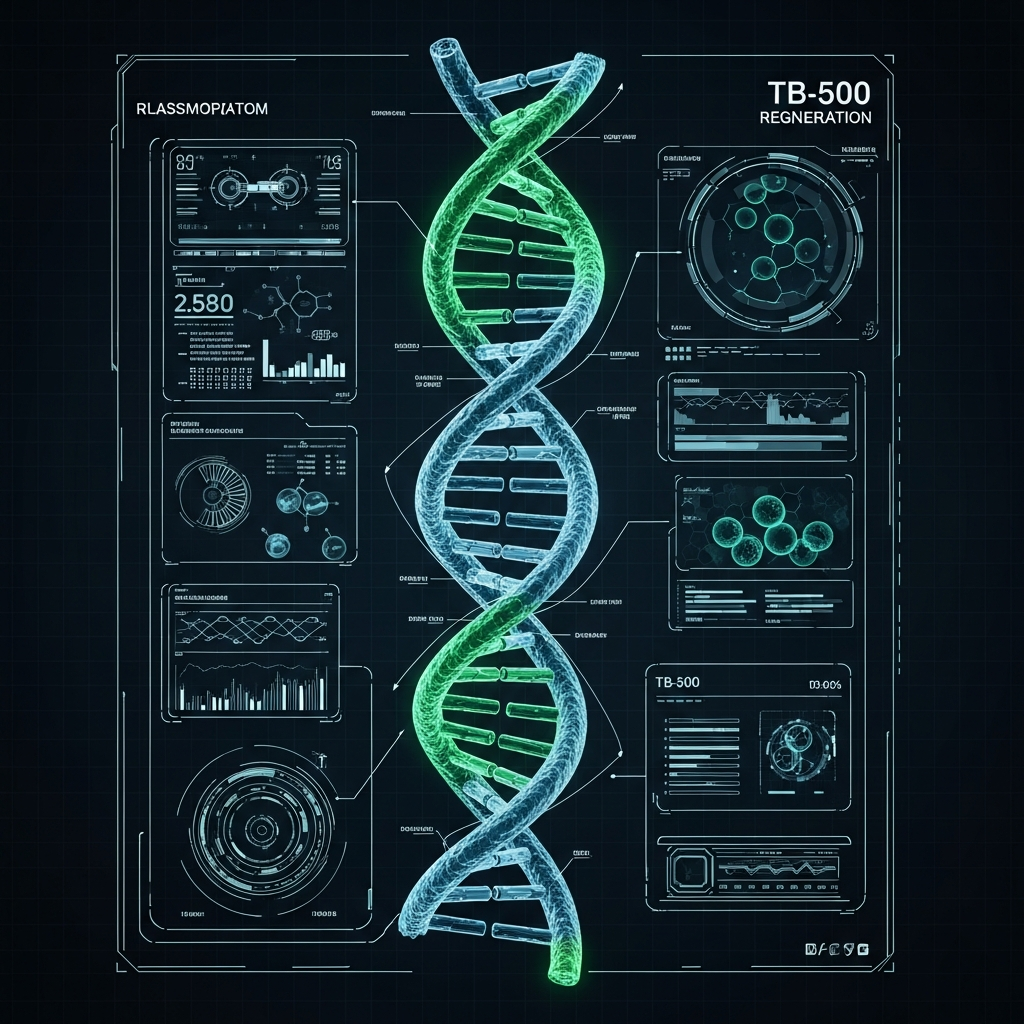
TB-500 is the architect of cellular repair. Where other peptides send signals, TB-500 addresses the physical foundation: Actin regulation. It facilitates cell migration, forces angiogenesis, and accelerates regeneration beyond the biological baseline.
The peptide that makes tissue move
In most research protocols, repair is approached as a passive process — a growth factor sends a signal, and the cell does the rest. TB-500 (Thymosin Beta-4 fragment) breaks with that assumption entirely. It is not a growth factor. It is a structural regulator that directly intervenes in the actin cytoskeleton — the molecular machinery by which cells move, migrate, and organize around an injury site.
"Without cell migration, there is no repair. TB-500 is not a signal — it's the road on which every repair-signal travels."
What does TB-500 do razor-sharp differently?
TB-500 is a synthetic fragment of the naturally occurring protein Thymosin Beta-4 — specifically the 17-amino acid sequence responsible for actin sequestration and cell mobilization. Isolated in a stabilized peptide form, it performs the following in in-vitro models:
- G-actin sequestration → liberation of the actin pool for rapid re-polymerization
- Cell migration acceleration → cells move up to 3x faster to the injury site
- Angiogenesis induction → new capillary networks form within 72 hours in in-vitro assays
- Anti-fibrotic action → less scar tissue, more functional recovery
- Endothelial regeneration → vasculature repair at molecular level
- Systemic distribution → adipose tissue-independent biodistribution via lymphatic system
TB-500 vs GHK-Cu — Side-by-Side
| Property | TB-500 (Thymosin β-4 fragment) | GHK-Cu (Copper Tripeptide) |
|---|---|---|
| Mechanism of action | Actin regulation · cell migration | Gene modulation · DNA repair |
| Amino acid count | 17 (stabilized fragment) | 3 (tripeptide) |
| Co-factor | None | Copper (Cu²⁺) — mandatory |
| Primary output | Cell migration · angiogenesis | Gene expression · collagen synthesis |
| Target tissue | Vasculature · muscle · ligament · tendon | Skin · connective tissue · hair follicles |
| Half-life in-vitro | ~2-3 hours (rapid) | ~4-6 hours (medium) |
| Exposure route (research) | Subcutaneous / IM (in-vitro models) | Topical / subcutaneous |
| Anti-fibrotic effect | Strong | Moderate |
| HPLC-purity Primal lot | ≥99% | ≥99% |
| Reconstitution | Bacteriostatic water · −20 °C | Bacteriostatic water · −20 °C |
| Typical research instrument | Acute injury / vascular models | Chronic / cosmetic research |
The conclusion is razor-sharp: GHK-Cu is an excellent gene modulator for slow, chronic processes. TB-500 is the peptide for acute, targeted tissue repair research where cell migration is the bottleneck. They are complementary tools — not competitors.
Why researchers procure TB-500
TB-500 is deployed by serious research groups for one reason: it is the only peptide in the mainstream research instrument that directly intervenes in physical cell movement rather than chemical signaling.
The 4 reasons why TB-500 makes the Vault protocol:
- Verified HPLC ≥99% purity per Primal lot · Janoshik 3rd-party certificate
- Reproducible angiogenesis data in in-vitro vascular models — measurable capillary density
- Synergistic with BPC-157 — jointly deployable for dual-pathway recovery research (BPC sends signal, TB-500 delivers mobility)
- Vacuum-sealed integrity — Primal Peptides dispatches only batches stored in our EU lab under strict −20 °C storage protocols · vacuum-sealed packaging · discrete EU dispatch
No marketing claims. Only reproducible lab data and lot trace.
TB-500 accelerates cell migration without discrimination. In research models, careful control is required regarding which tissues are included in the response — every cell with actin machinery responds to the signal. For in-vitro use, applicable only to isolated cell populations with clear control cultures.
Legal disclaimer: TB-500 is intended exclusively for IN-VITRO RESEARCH. Not for human or animal use. Not for consumption.
The Primal Peptides standard
Every batch is independently validated. The Certificate of Analysis (COA) is the binding source of truth for each lot — publicly available, batch-specific, and generated by an independent third-party laboratory prior to dispatch. We publish no claims not supported per lot by the COA.
- 01RP-HPLC with UV detection → purity ≥ 98–99%
- 02Mass spectrometry → molecular mass confirmation
- 03Janoshik 3rd-party verification → public COA per lot
Our validation architecture is deliberately minimalist and rigorous: three reproducible assays, one independent verification, one public certificate. For the complete analytical dossier of your specific batch, consult the COA included with your shipment or via our public verification page.
Conclusion — The architect of repair
TB-500 is not the peptide that initiates signal cascades. It is the peptide that gives the cell the physical means to move to the injury site and remain there until the work is done. For researchers seeking to optimize their in-vitro repair protocols beyond signal modulation, TB-500 is the missing mobility foundation.
Movement first. Then mending.
TB-500
Primal Peptides EU laboratuvarından doğrudan referans standardı — vakum-mühürlenmiş, anonimleştirilmiş ve AB içinde diskret sevk edilir. Sevkiyat öncesi sıkı −20 °C depolama protokolleri lot-bütünlüğünü garanti eder.
YALNIZCA IN-VITRO ARAŞTIRMA İÇİN · İNSAN KULLANIMI İÇİN DEĞİL · GMP-UYUMLU SENTEZİ