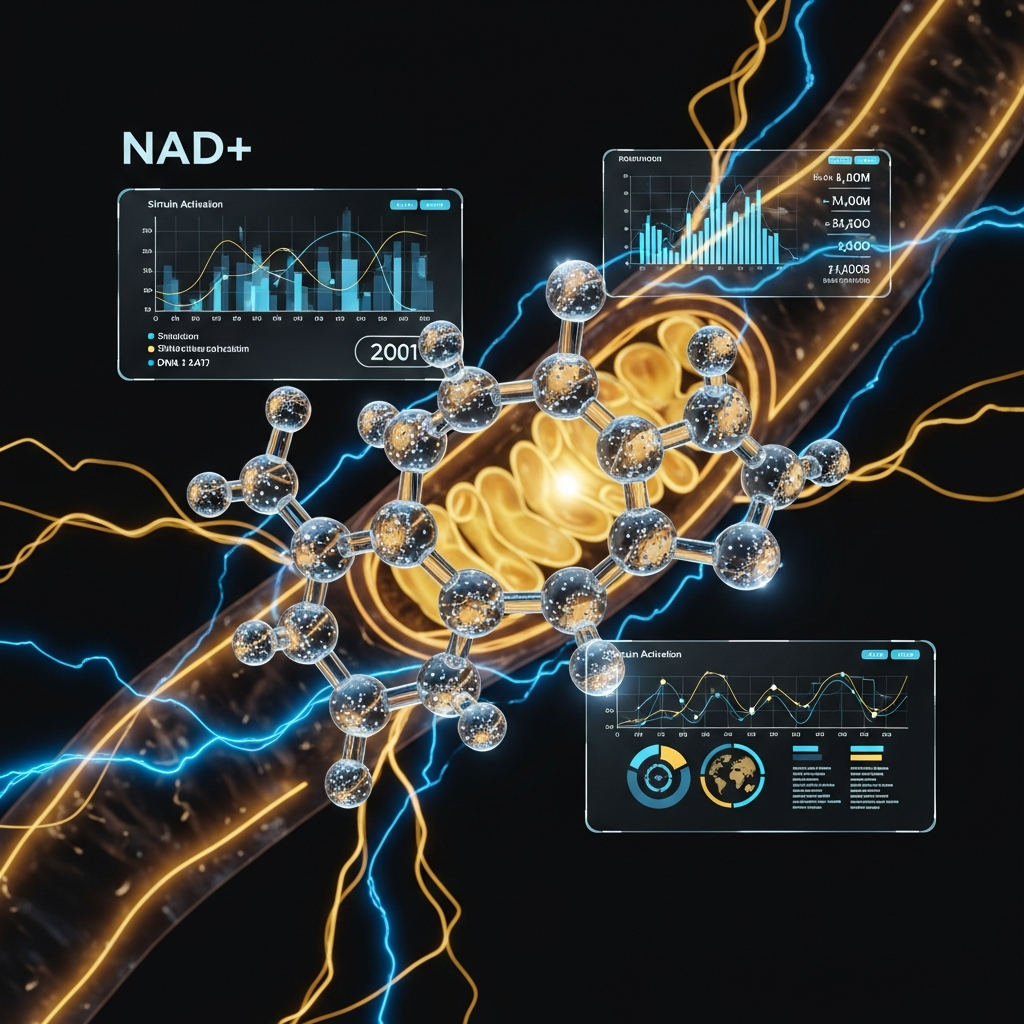
NAD+ is not a vitamin, not a supplement. It is the master redox cofactor of cellular energy metabolism — a dinucleotide (Nicotinamide Adenine Dinucleotide, MW: 663.43 g/mol) that operates as substrate and cofactor for hundreds of enzymes: from ATP production via glycolysis and oxidative phosphorylation, to sirtuin activation (SIRT1-7), PARP-mediated DNA repair and CD38-cyclic ADP-ribose signaling. No other molecule sits this deep in this many pathways simultaneously.
The Biochemical Foundation — A Dinucleotide That Defines the Cellular Energy Paradigm
In the biochemical research field, NAD+ is not an "interesting research molecule" — it is the pivot of cellular energy metabolism itself. Without NAD+ there is no glycolysis, no citric acid cycle, no electron transport chain, no ATP production. Every cell in every organism lives or dies on the NAD+/NADH ratio.
NAD+ levels decline with chronic cellular stress. Recent research (2010-2020) has demonstrated that NAD+ pools in chronic research models are significantly lower than baseline — a research question that has grown explosively: can supplementation restore the NAD+ pool and improve ATP production + sirtuin activity + DNA repair efficiency?
The question became more complex when precursors (NMN, NR) entered the market. They are converted via NMNAT (NMN → NAD+) or NRK (NR → NMN → NAD+) — efficient, but one to two steps removed from the end product. Direct NAD+ research administration bypasses the conversion steps and delivers the functional molecule directly.
NAD+ (Nicotinamide Adenine Dinucleotide, MW: 663.43 g/mol) consists of two nucleotides (nicotinamide-ribose and adenosine) connected by two phosphates. The C4-position of the nicotinamide residue is the redox-active site — where electrons are accepted (NAD+ → NADH) and released again (NADH → NAD+) in a continuous cycle.
"ATP is the currency. NAD+ is the bank. Sirtuins are the depositors. Without NAD+, the whole economy collapses."
In this respect, NAD+ is fundamentally different from classical research "energy supplements" — it does not work via central stimulation, not via receptor binding, and not as a nutrient. It operates intracellularly as substrate-cofactor for hundreds of enzymes simultaneously — the most fundamental cofactor in cellular bioenergetics.
What Does NAD+ Do Razor-Sharp Differently?
NAD+ (Nicotinamide Adenine Dinucleotide, MW: 663.43 g/mol) operates at the most fundamental level of cellular energy architecture:
- Glycolysis cofactor (GAPDH step) → glucose → pyruvate via NADH formation
- Citric acid cycle cofactor (4 enzymatic steps) → acetyl-CoA → CO₂ + NADH
- Electron transport chain → NADH → NAD+ + ATP via Complex I oxidation
- Sirtuin (SIRT1-7) substrate → NAD+-dependent deacetylation of histone/non-histone proteins
- PARP (Poly-ADP-Ribose Polymerase) substrate → NAD+-mediated DNA repair signaling
- CD38 cyclase substrate → ADP-ribose (cADPR) cellular signaling
- Directly available for cellular uptake without enzymatic conversion (unlike precursors)
NAD+ vs Precursors (NMN/NR) — Side-by-Side
| Property | NAD+ (Direct Cofactor) | NMN/NR (Precursors) |
|---|---|---|
| Type | Complete dinucleotide | Nucleoside (NR) or mononucleotide (NMN) |
| Molecular mass | 663.43 g/mol | NMN: 334.22 g/mol · NR: 255.25 g/mol |
| Steps to functional | 0 (directly functional) | NMN: 1 step (NMNAT) · NR: 2 steps (NRK + NMNAT) |
| Conversion efficiency | n/a (no conversion required) | High · but enzyme-capacity-dependent |
| Sirtuin substrate | Direct (SIRT1-7 cofactor) | Indirect via NAD+ conversion |
| PARP substrate | Direct (DNA repair signaling) | Indirect via NAD+ conversion |
| Cellular uptake | Limited (membrane-impermeable, requires transporters) | Superior (slc12a8 for NMN, equilibrative transporters for NR) |
| Mitochondrial NAD+ pool | Directly supported (mNAD+ via SLC25A51) | Requires conversion first |
| Research window | Acute NAD+ response | Chronic NAD+ pool support |
| Cofactor stoichiometry | 1:1 (NAD+ to target enzyme) | NMNAT-dependent flux |
| HPLC-purity Primal lot | ≥99% | n/a (different supply chain) |
| Optimal research role | Direct NAD+ cofactor demand testing · enzyme kinetics · sirtuin research | Chronic NAD+ pool restoration · long-term cellular energy research |
| Intracellular half-life | Rapid turnover (constant recycling) | Variable depending on conversion efficiency |
| Synergy | Cofactor architecture reinforces both direct and chronic pool | Cofactor architecture reinforces direct + reservoir |
The biochemical conclusion: NMN and NR are excellent precursors for chronic NAD+ pool restoration — efficiently absorbed, high conversion to NAD+, longer exposure windows. NAD+ itself is the direct functional cofactor — no conversion step, immediately available for sirtuin/PARP/CD38 enzymatic research, ideal for enzyme kinetics studies and acute NAD+ response models. Not substitutes — different tools for different questions. For research mechanistically testing NAD+ cofactor function, direct NAD+ is preferred. For cellular pool restoration, NMN/NR are often more practical.
The Molecular Mechanics
At the level of mitochondrial bioenergetics and cellular ATP metabolism, the following NAD+ functions are documented:
- Glycolysis GAPDH step → glyceraldehyde-3-phosphate → 1,3-bisphosphoglycerate + NADH (cytosolic)
- Pyruvate dehydrogenase complex (PDH) → pyruvate → acetyl-CoA + NADH (mitochondrial matrix)
- Citric acid cycle → isocitrate dehydrogenase, α-KG dehydrogenase, malate dehydrogenase produce 3 × NADH per cycle
- Complex I (NADH dehydrogenase) → NADH oxidation + proton pump → ΔμH⁺ across inner membrane
- ATP synthase → ΔμH⁺ → ATP production (Complex V)
- NAD+/NADH ratio in mitochondria ≈ 7-8, in cytosol ≈ 700-1000 → redox-driven compartmentalization of flux
For research into sirtuin-mediated epigenetic regulation, NAD+ provides a direct substrate-supplier role — a research domain where indirect cofactors cannot reach:
- SIRT1 (nuclear/cytoplasmic) → deacetylation of p53, FOXO3a, PGC-1α, NF-κB
- SIRT3 (mitochondrial) → deacetylation of MnSOD, IDH2, LCAD → oxidative metabolism response
- SIRT6 (nuclear) → DNA repair, telomere maintenance, NF-κB response dampening
- PGC-1α activation via SIRT1-NAD+-dependent deacetylation → mitochondrial biogenesis
- CREB phosphorylation cascade via SIRT1-cAMP cross-talk → energy sensor pathway
- Klotho expression elevated in NAD+-rich cellular research models → anti-aging response marker
The most unique NAD+ property is that it simultaneously supports both ATP production and DNA repair — a research domain where the two functions are normally viewed as competing:
- PARP-1 substrate → poly-ADP-ribosylation at DNA strand breaks → repair machinery recruitment
- PARP-2 and PARP-3 → secondary DNA repair pathways, likewise NAD+-dependent
- PARP overactivation in chronic stress → NAD+ depletion → cellular energy crash (research-relevant feedback)
- NAD+ restoration supports both ATP and DNA repair efficiency in chronic research models
- CD38 cyclase competes with sirtuins for NAD+ → CD38 modulation + NAD+ supplementation
- Genomic integrity in senescent cell cultures improved via NAD+ + sirtuin pathway support
The Primal Peptides Standard
Every batch is independently validated. The Certificate of Analysis (COA) is the binding source of truth for each lot — publicly available, batch-specific and generated by an independent third-party laboratory prior to shipment. We publish no claims not per-lot supported by the COA.
- 01RP-HPLC with UV detection → purity ≥ 98–99%
- 02Mass spectrometry → molecular mass confirmation
- 03Janoshik 3rd-party verification → public COA per lot
Our validation architecture is deliberately minimalist and rigorous: three reproducible assays, one independent verification, one public certificate. For the complete analytical dossier of your specific batch, consult the COA with your shipment or via our public verification page.
NAD+ is a central metabolic cofactor and modulates hundreds of enzymatic pathways simultaneously. Research protocols must strictly control NAD+/NADH baselines, mitochondrial ATP/ADP ratios, SIRT1 activity and any co-administration with other NAD+ modulators (NMN, NR, NNMT inhibitors, CD38 references, PARP inhibitors) in animal models. NAD+ pool support can cause extensive metabolite and signaling responses requiring parallel monitoring.
Legal disclaimer: NAD+ is intended exclusively for IN-VITRO RESEARCH. Not for human use. Not for consumption. Not for self-administration as energy or anti-aging supplement.
Conclusion — The Architect of Biological Rejuvenation
NAD+ is not an energy supplement. It is the master redox cofactor of cellular metabolism — a dinucleotide that operates as direct substrate and cofactor supplier for hundreds of enzymes simultaneously: ATP production via glycolysis and oxidative phosphorylation, sirtuin-mediated epigenetic deacetylation, PARP DNA repair and CD38 cyclase signaling — all dependent on a high NAD+/NADH ratio. For researchers studying mitochondrial bioenergetics, sirtuin activity, DNA repair efficiency or cellular longevity in a molecularly targeted manner — with direct cofactor availability instead of precursor-dependent conversion — NAD+ is the missing fundamental-energetic research instrument.
Cofactor over consumable. Cycle over crash. Architecture over ATP.
NAD+
Reference standard directly from the Primal Peptides EU lab — vacuum-sealed, anonymised and discreetly shipped within the EU. Strict −20 °C storage protocols before dispatch guarantee lot-integrity.
FOR IN-VITRO RESEARCH ONLY · NOT FOR HUMAN USE · GMP-COMPLIANT SYNTHESIS